
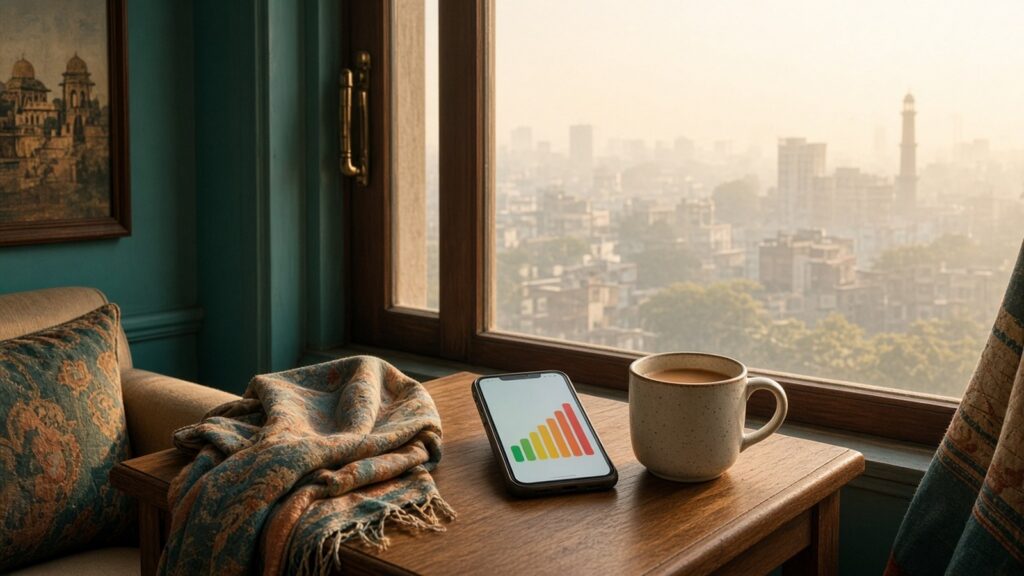
Every winter, Delhi NCR families start checking two things before they plan the day: the AQI number, and whether GRAP has moved up a stage. The Graded Response Action Plan sounds like something only officials talk about. In practice, it changes school timings, construction noise outside your window, whether outdoor PE happens, and how hard the commute feels on your chest.
This guide is a plain-language decoder of GRAP asthma Delhi families can actually use. You will see what each stage roughly means for school, outdoor exercise, construction and commuting, how to plan a day when stages shift overnight, and when to treat symptoms seriously. It is not a general AQI colour chart. It is about the stage ladder and the decisions that sit on top of it in early November smog season.
This article is general education, not medical advice. Everyone’s asthma is different. Please talk to a doctor about individual symptoms and treatment, and never start, stop or change any asthma medicine based on a blog post.
1. What GRAP is, in everyday language
GRAP stands for Graded Response Action Plan. Think of it as a ladder of public measures that kick in as air quality in Delhi NCR gets worse. Lower stages bring lighter restrictions. Higher stages bring stricter ones on construction, some vehicles, outdoor activity at schools, and other daily routines that shape how much dusty, smoky air you meet.
You do not need to memorise every official circular. You do need a working sense of: which stage we are in today, what usually changes for families, and how that interacts with your asthma plan. Stages can move up quickly after Diwali crackers, a windless night, or a stretch of stubble-burning smoke drifting into the region.
For a broader picture of how numbers and colours relate to breathing, see our guide to AQI and asthma in India. For the lived reality of the region itself, our article on living with asthma in Delhi NCR covers day-to-day coping beyond the stage labels.
2. How stages connect to AQI (without turning into a textbook)
Officials use air-quality categories and forecast models to decide when to activate or escalate GRAP. Families usually experience it as: yesterday was Stage II, this morning WhatsApp says Stage III, and the school just messaged about outdoor assembly.
A few practical truths help more than memorising thresholds:
- Stages are about actions, not feelings. Your chest may feel rough even on a lower stage day if you are sensitive, or on a dusty local street that is worse than the city average.
- Forecasts and local pockets differ. A monitor near a highway, landfill fire or construction site can look harsher than a quieter neighbourhood a few kilometres away.
- Night and early morning often feel worse. Cooler air and calm winds can trap pollution close to the ground when you step out for school or office.
- Stage jumps can be sudden. Plan for the stage you wake up to, and keep a backup indoor plan for PE, walks and errands.
If you want a month-by-month winter rhythm for North India, our winter asthma guide for North India pairs well with watching GRAP through November and December.
3. Stage I and Stage II: what usually changes for asthma families
Lower stages are easy to shrug off because life still looks “normal” from the outside. For many people with asthma, this is exactly when irritation starts creeping in: more coughing on the scooter, tighter mornings, and children who seem fine indoors but wheezy after outdoor games.
School and outdoor play
- Outdoor assembly or PE may still run, but it is worth asking the teacher how they decide when to move activities indoors.
- Carry the child’s reliever as advised by their doctor, and make sure the school knows where it is kept.
- If your child usually walks or cycles to school, consider a shorter outdoor stretch or a covered route when the morning looks hazy.
Commuting and errands
- Prefer metro or well-sealed car rides over long open two-wheeler trips when you can.
- If you must use a scooter or walk, a well-fitting mask that you can actually breathe in may help some people. See our practical guide to picking an N95 you can breathe in.
- Batch outdoor chores for the clearer part of the day, often late morning rather than early dawn, though local patterns vary.
Home and windows
- Keep a cleaner-air room idea ready: one bedroom where windows stay shut during the worst hours, with a purifier if you have one.
- Avoid adding indoor smoke from incense or mosquito coils on the same days outdoor air is already heavy.
4. Stage III: when the day needs a clearer Plan B
Stage III is when many families feel the shift. Construction may face tighter curbs, some vehicles and activities get restricted, and schools often rethink outdoor sports. For asthma, the question is less “What is the exact rule?” and more “How do I protect today without panic?”
Day-planning ideas when GRAP stage 3 asthma concerns are high on your mind:
- School: Check the school message early. If outdoor PE is cancelled, that is usually a relief, not a loss. Ask whether recess stays outdoors and whether dusty corridors are being wet-mopped.
- Work commute: Leave buffer time. Traffic patterns change when restrictions kick in, and stressed, rushed breathing on a polluted road is a poor mix.
- Exercise: Move workouts indoors. Mall walking, home routines or a gym with decent filtration beat outdoor jogging on a Stage III morning. Our guide on exercise when air quality is poor has more options.
- Children’s play: Prefer indoor playdates. If they insist on the park, keep it short, watch for coughing or unusual tiredness, and head home without a debate if symptoms start.
- Construction next door: Even with city-wide curbs, dust can linger. Keep windows on that side shut, and wet-wipe sills rather than dry-dusting.
Pollution’s wider impact on airways is covered in our article on air pollution and asthma. Use it when you need language to explain to relatives why you are skipping the morning walk.
5. Stage IV and emergency-feeling days
The highest stage is uncommon, but when it arrives, treat the day as a high-protection day for lungs. Work-from-home requests, cancelled outdoor events and stricter movement rules are signals, not inconveniences to power through for pride.
- Minimise non-essential outdoor time, especially for young children and older adults with asthma.
- Keep reliever inhalers where you can reach them, including in the school bag and work bag if that is part of your usual plan from your doctor.
- Watch for early warning signs: night cough that is worse than usual, wheeze, chest tightness, or needing the reliever more often than your personal pattern.
- Do not invent new doses on your own. If you feel you need a change, talk to your doctor or seek urgent care.
Call 112 or go to the nearest emergency department if breathing becomes severe, speaking full sentences is hard, lips look blue or grey, or the reliever is not helping. A GRAP stage is never a reason to wait and see when someone is struggling to breathe.
6. A simple daily checklist for smog-season mornings
Screenshot this for November mornings in Delhi NCR:
- Check today’s GRAP stage and a trusted AQI reading for your area before planning outdoor time.
- Decide school outdoor activity: go / shorten / skip.
- Choose commute mode with the least open-air exposure you can manage.
- Pack reliever, mask if you use one, and a water bottle.
- Keep one indoor backup for exercise or children’s play.
- Note symptoms in a phone note if the day feels different from usual.
- If symptoms escalate, follow your written asthma action plan and contact a doctor or emergency services as needed.
7. Talking to schools, offices and family about stages
GRAP only helps your household if people around you take it seriously. Short scripts work better than long lectures.
- To a class teacher: “When GRAP is at Stage III or above, we prefer indoor PE for our child. Happy to share our asthma action plan contact sheet.”
- To a manager: “On high GRAP days I may need flexible start times or work from home to avoid peak outdoor exposure. I will still deliver my work.”
- To relatives who say you are overreacting: “I am not cancelling life. I am changing the outdoor parts on the worst air days so I stay well enough to enjoy the rest.”
You are not being dramatic. You are matching the day to the air in front of you.
8. What GRAP does not do (so you do not get false comfort)
- It does not clean the air inside your home by itself. Indoor cooking smoke, incense and dust still matter.
- It does not replace your personal asthma plan or prescribed medicines.
- It does not mean every street is equally safe at a given stage.
- It does not mean you should wait for Stage IV before protecting yourself if you already feel unwell on a Stage II morning.
Use GRAP as a city-wide signal, then layer your own common sense: how your chest feels, what your doctor has advised, and what your day actually requires outdoors.
Siddhant’s POV: Stages on the phone, air in my chest
I have lived with asthma for more than 30 years, including many winters when Delhi NCR air felt like a daily negotiation. Checking a stage on a phone never felt abstract to me. It decided whether a walk felt wise, or whether I should stay closer to cleaner indoor air.
My breathing improved after I moved from Delhi NCR to Dehradun. That change made the GRAP season even clearer in hindsight: stages are useful, but leaving the worst air behind helps more than any single day of restrictions. If you cannot move, you can still treat each stage as a real planning tool, not just a headline.
Siddhant Jain, founder of Asthma Friend, has lived with asthma for more than 30 years.
Conclusion
GRAP is the city’s way of saying the air needs stronger protection today. For asthma families in Delhi NCR, the useful skill is translating each stage into school choices, commute choices, exercise choices and knowing when to seek help. Watch the stage, watch your symptoms, keep indoor backups ready, and talk to your doctor about your personal plan. You do not have to become an air-policy expert. You only need a calmer morning checklist when the haze settles in.
Take the next step with Asthma Friend
- Join our community: Connect with people who understand life with asthma at Asthma Friend.
- Learn through play: Explore free educational games at Asthma Friend Games.
- Create your free asthma action plan: Use the Asthma Friend Action Plan Generator and keep a copy handy.
Frequently asked questions
GRAP is a ladder of public measures that tighten as Delhi NCR air quality worsens. For families, it often changes school outdoor activity, construction dust, commuting options and how carefully you plan time outside.
Not always. Local pockets can be worse than the city stage suggests, and individuals differ. Many people still prefer shorter outdoor sessions or indoor exercise when mornings look hazy. Follow how you feel and your doctor’s advice.
Indoor PE and limiting long outdoor assemblies are common helpful moves. Parents can share an action plan contact sheet and ask where the child’s reliever is stored.
AQI describes how polluted the air is. GRAP describes actions the region may take in response. Families need both: the number for personal decisions, and the stage for school, traffic and construction changes.
Do not start, stop or change medicines on your own because a stage went up. Talk to your doctor if symptoms are increasing or if you are unsure what your action plan says.
Call 112 or go to emergency care for severe breathlessness, trouble speaking, blue or grey lips, or a reliever that is not helping. Do not wait for the stage to change.
Last reviewed: 8 November 2026
Information on this page was written against widely published guidance from national and international respiratory health bodies. It is educational only and is not a substitute for personal medical advice from a doctor.

About the author
Siddhant Jain
Siddhant Jain is the founder of Asthma Friend. He has lived with asthma for more than 30 years. After moving from Delhi NCR to Dehradun, his breathing improved, and he built Asthma Friend to give Indian patients and caregivers practical, empathetic education. The content is educational and is not a substitute for advice from a doctor.
Related posts:
 Is Asthma Hereditary? What Parents with Asthma Should Know About Their Children
 The Role of Nebulizers in Asthma Management
 Room Heaters and Asthma in India: Oil-Filled vs Fan vs Halogen, Angithi Smoke and Safe Winter Warmth
 How to Create an Asthma Friendly Bedroom for Better Sleep
 Asthma & Mountains: Does Clean Air Really Help?
 Asthma and India’s AQI in Stubble Season: How to Read the Colours and Plan Your Day
 Smog or Fog? Why Hazy Winter Mornings Are Not All the Same for Asthma
 Diwali and Asthma: How to Celebrate Safer When Fireworks and Smoke Fill the Air
 Air Purifiers for Asthma in Indian Homes: HEPA, CADR, Room Size and a Winter Smog Setup
 Closing Windows on Smog Days: How to Ventilate Without Letting Pollution In