
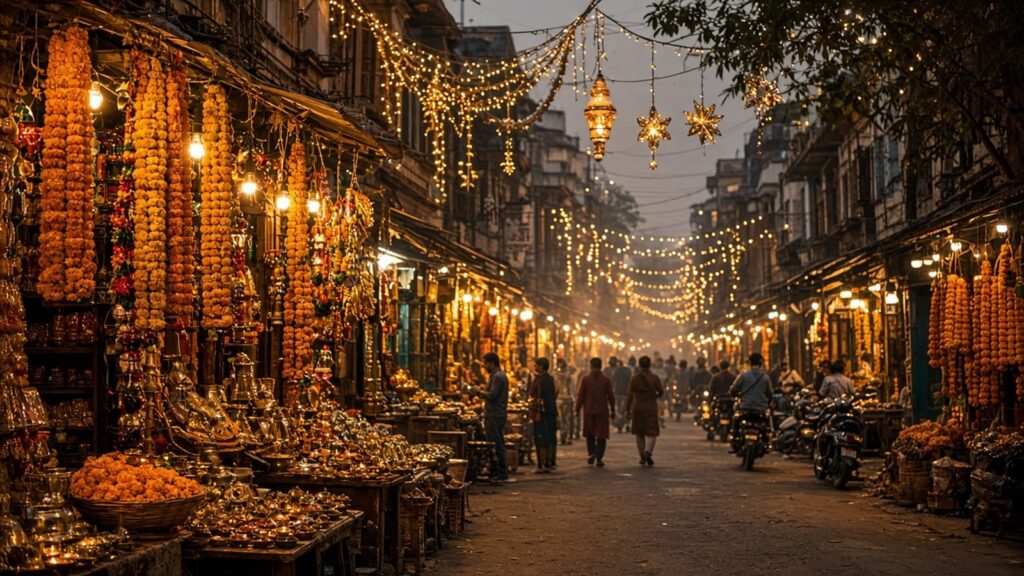
Dhanteras and the days around Diwali pull families into packed lanes: jewellery shops, utensil markets, clothing bazaars and last-minute gift stalls. For someone with asthma, that festive rush can mean dust, generator fumes, perfume samples, crowd heat and slow exits. This guide is about crowded market asthma planning for Indian festival shopping, not about skipping Diwali joy.
You will get timing tips, what to carry, how to choose lanes and exits, when online shopping is the kinder option, and when to leave without finishing the list. Pair it with common sense and your doctor’s advice.
This article is general education, not medical advice. Everyone’s asthma is different. Please talk to a doctor about individual symptoms and treatment, and never start, stop or change any asthma medicine based on a blog post.
1. What makes festival markets harder on breathing
A bazaar in peak season is a mix of outdoor and semi-covered air. Stall canopies trap smells. Generators for lights and billing machines add fumes. Dry goods, fabric fibres and rangoli powders kick up dust when someone sweeps. Autos idle at the entrance.
Triggers people often notice:
- Road dust and construction grit near market approaches.
- Diesel generator exhaust behind denser stall rows.
- Strong perfume, agarbatti and room-freshener demos at gift counters.
- Crowd heat that makes breathing feel heavier even without wheeze.
- Long queues where you cannot easily step aside.
- Firecracker haze drifting in from nearby residential lanes in the evening.
If you are also choosing gifts for someone with asthma, our separate guide to Diwali gift ideas that stay trigger-aware can help the shopping list itself. For reading the day’s air, keep the AQI guide for asthma in India open on your phone.
2. Decide whether this trip needs to be in person
Not every item deserves a packed-lane visit on a red AQI afternoon. Sort your list before you leave home.
- Must-see in person: jewellery sizing, utensils you need to hold, clothes you must try.
- Can be online or neighbourhood store: packaged dry fruits, simple decor, repeat grocery gifts, many electronics.
- Can wait a quieter morning: non-urgent browsing that usually turns into two extra hours in the crowd.
If someone in the family had a rough asthma night, treat the market trip as optional. Sending one person without asthma, or splitting the list across two shorter visits, is a valid plan.
3. Timing: beat the worst overlap of dust, traffic and crackers
Festival markets are not equally hard all day. Timing is one of the few free tools you control.
- Prefer late morning on many days, after early traffic settles and before evening rush and cracker smoke build.
- Check AQI and the local smell test before you commit to an evening jewellery lane.
- Avoid the hour when office autos, school pickups and market rush collide at the same junction.
- If fireworks are already loud nearby, shorten the outdoor portion and finish indoors or online.
- Build a hard end time. Open-ended browsing is how mild tightness becomes a long exit struggle.
4. What to carry in a small market kit
Keep the kit light enough that you will actually bring it. Heavy bags make crowd movement harder.
- Reliever inhaler in a front zip pocket, not buried in shopping bags.
- Spacer if your clinician has advised one for you.
- A mask you can tolerate for dusty stretches; fit and comfort both matter. See our guide to picking an N95 you can actually breathe in.
- Water bottle and a few tissues.
- Phone with battery for maps, UPI and calling a family member at the entrance.
- A written or phone note with emergency contacts.
A home-level kit checklist lives in our article on creating an asthma emergency kit. For market day, take only the portable pieces.
5. Lane, stall and exit tactics
Once you are in the market, small routing choices change how much dust and fume you swallow.
Choose your path
- Prefer wider lanes with clearer sky overhead when the covered alley smells of generator exhaust.
- Stand upwind of incense demo stalls and perfume sprayers when you can see the mist.
- Skip optional fabric-cutting counters if dry fibre dust bothers you; send a companion or shop elsewhere.
- Keep children with asthma toward the quieter edge of a stall, not pressed into the densest knot of people.
Plan the exit before you bargain
- Note two ways out when you enter a dense gully.
- Agree a meeting point near the main road if the group splits.
- If tightness starts, leave the bargain unfinished. Another shop will exist tomorrow.
- Do not wait inside a dead-end stall row hoping the crowd thins while your chest worsens.
6. Autos, parking edges and ride smells
The trip to and from the market can be as irritating as the market itself. Idling autos, scented hanging cards and closed cabins after a dusty walk deserve attention.
- Ask drivers to remove or bag strong air fresheners if the smell hits you immediately.
- Crack a window if outdoor air is acceptable; keep it shut if the roadside AQI is clearly worse.
- Avoid waiting in a cloud of generator or truck exhaust at the market gate.
- If a rideshare spray bothers you, say so early. Our guide on handling fragrances in autos, taxis and rideshares has polite scripts.
For wider city travel ideas, see asthma and public transport tips for safer travel in India.
7. Shopping with children or older parents who have asthma
Mixed-age festival trips need extra margins. Children may not name tightness clearly. Older adults may push through out of habit.
- Keep trips shorter than the social plan suggests.
- Carry the child’s inhaler on the adult, not in a stroller basket under shopping bags.
- Schedule a sit-down drink break in a cleaner indoor spot halfway through.
- Watch for early signs: unusual quietness, cough clusters, saying the chest feels heavy, needing to stop walking.
- Give permission out loud: “We can leave whenever breathing feels off. The market will still be there.”
8. When to abandon the list and go home
Leaving early is a success if it protects the evening. Go home or move indoors if:
- Reliever use is climbing beyond your usual pattern for a simple outing.
- Speaking while walking becomes hard.
- Crackers or generator smoke thicken suddenly in your lane.
- A child asks repeatedly to sit or looks unusually tired for the distance walked.
- You feel panicked in a crowd and cannot find clear air quickly.
Call 112 or go to the nearest emergency department for severe breathlessness, difficulty speaking full sentences, blue or grey lips, or a reliever that is not helping. Do not wait in a market queue for medical danger to pass.
9. A sample Dhanteras half-day plan
Adapt this template to your city and family:
- Night before: Finalise must-buy list, pack inhaler kit, charge phone, decide end time.
- Morning: Check AQI. If severe, shift non-essential items online.
- Late morning arrival: Park or alight at the quieter edge. Confirm exit points.
- One focused lane first: Finish the highest-priority purchase while energy is fresh.
- Short sit-down break: Water, quiet minutes, symptom check.
- Second short lane or go home: Stop while breathing still feels steady.
- Afternoon rest: Low-scent room, light meal, no incense victory celebration if chests are sensitive.
10. Masks, powders and last-minute decor stalls
Some stalls create a denser cloud than others. Dry colour powders, chalk rangoli mixes, loose glitter and stacked synthetic flowers shed particles when shoppers dig through heaps.
- If rangoli powder stalls make you cough, send a companion or switch to flower-petal decor bought elsewhere.
- Shake fabric bags outdoors away from your face before putting them in a closed car boot.
- Keep masks for the dustiest stretches rather than arguing with yourself about wearing one all day if that feels too hard; consistency on the worst lanes still helps.
- Wash hands before touching your eyes or inhaler mouthpiece after handling dusty goods.
Online orders for decor can feel less festive, yet they often mean less dust in your chest the same evening. Festive feeling comes from people and light more than from standing in a powder aisle.
11. After you get home: reset without more smoke
The market trip is only half the story. Coming home with dusty bags into a room full of incense can undo the care you took outdoors.
- Leave shopping bags near the door and unpack slowly without beating fabric in the bedroom.
- Change out of dusty outer clothes before long rest on the bed.
- Skip victory incense or strong floor cleaner right after a polluted outing.
- Drink water, sit quietly and notice whether cough settles.
- If symptoms climb through the evening, follow your written action plan and contact your doctor. Do not invent new doses.
Families sometimes feel pressure to keep shopping until every relative is gifted. Asthma changes the cost of that pressure. A shorter list completed safely is better than a perfect list that ends in emergency care.
12. Budget pressure and family expectations
Sometimes the hardest part is not dust; it is the relative who insists you must visit one more lane. Asthma planning includes social scripts.
- Decide your must-buy list with the household before you reach the market gate.
- Offer a clear alternative: “We will finish these three shops, then head back. Online can cover the rest tonight.”
- Blame the clock and air quality rather than arguing about who cares more about Diwali.
- If gift obligation is the issue, suggest pooled family gifts that need fewer stall stops.
Protecting breathing is not a failure of festivity. It is how you arrive at the celebration able to enjoy it.
Siddhant’s POV: The market can wait; the evening cannot
I have lived with asthma for more than 30 years, and festival markets used to feel like a test of willpower. My breathing improved after I moved from Delhi NCR to Dehradun, yet I still respect dusty lanes, generator smells and the way a crowd can close around you when you need space.
The practical lesson I keep is simple: buy what matters, leave before pride takes over, and treat early tightness as a signal. Diwali is longer than one afternoon in a packed gully.
Siddhant Jain, founder of Asthma Friend, has lived with asthma for more than 30 years.
Conclusion
Crowded market asthma care during Diwali shopping is mostly planning: shorter lists, better timing, a light kit, smarter lanes and a willingness to leave. Dust, traffic fumes and festival smoke are real, but they do not have to cancel the season. Choose in-person trips with intention, lean on online options when AQI or symptoms say so, and get emergency help quickly when breathing turns dangerous. Celebrate with a chest that can enjoy the evening you worked so hard to prepare.
Take the next step with Asthma Friend
- Join our community: Connect with people who understand life with asthma at Asthma Friend.
- Learn through play: Explore free educational games at Asthma Friend Games.
- Create your free asthma action plan: Use the Asthma Friend Action Plan Generator and keep a copy handy through the festive season.
Frequently asked questions
It can be manageable with timing, a short list, a ready inhaler kit and a clear exit plan. On severe AQI days or after a rough asthma night, shift non-essential buying online or to a quieter time.
Reliever inhaler, spacer if advised, a tolerable mask, water, charged phone and emergency contacts in a front pocket you can reach in a crowd.
Many people prefer late morning before evening traffic and cracker smoke build. Always check the day’s air quality and set a hard end time.
Only for short, planned trips with an adult carrying their inhaler. Watch early tiredness or cough and leave early without guilt.
Both can irritate sensitive airways in semi-covered lanes. Stand upwind when possible, skip optional demo stalls and leave if smell and tightness rise together.
Call 112 or go to the nearest emergency department for severe breathlessness, difficulty speaking, blue or grey lips, or a reliever that is not helping.
Last reviewed: 1 November 2026
Information on this page was written against widely published guidance from national and international respiratory health bodies. It is educational only and is not a substitute for personal medical advice from a doctor.

About the author
Siddhant Jain
Siddhant Jain is the founder of Asthma Friend. He has lived with asthma for more than 30 years. After moving from Delhi NCR to Dehradun, his breathing improved, and he built Asthma Friend to give Indian patients and caregivers practical, empathetic education. The content is educational and is not a substitute for advice from a doctor.
Related posts:
 Managing Asthma When Your Job Involves Long Calls or Presentations
 Diwali and Asthma: How to Celebrate Safer When Fireworks and Smoke Fill the Air
 Should You Exercise Outdoors When Air Quality Is Poor? Asthma Considerations
 Smog or Fog? Why Hazy Winter Mornings Are Not All the Same for Asthma
 Pigeons on Your Balcony and Asthma: Droppings, Feathers and Kabutarkhanas
 Keeping Your Inhaler Routine on Track During the Busy Diwali Week
 Asthma and Train Travel in India: A Preparation Checklist for Sleeper and AC Coaches
 Visiting Homes with Pets When You Have Asthma: Planning Without Blame
 Cold Air and Asthma: How to Plan Walks and Morning Commutes
 How to Prepare for an Asthma Appointment When You Feel Fine