
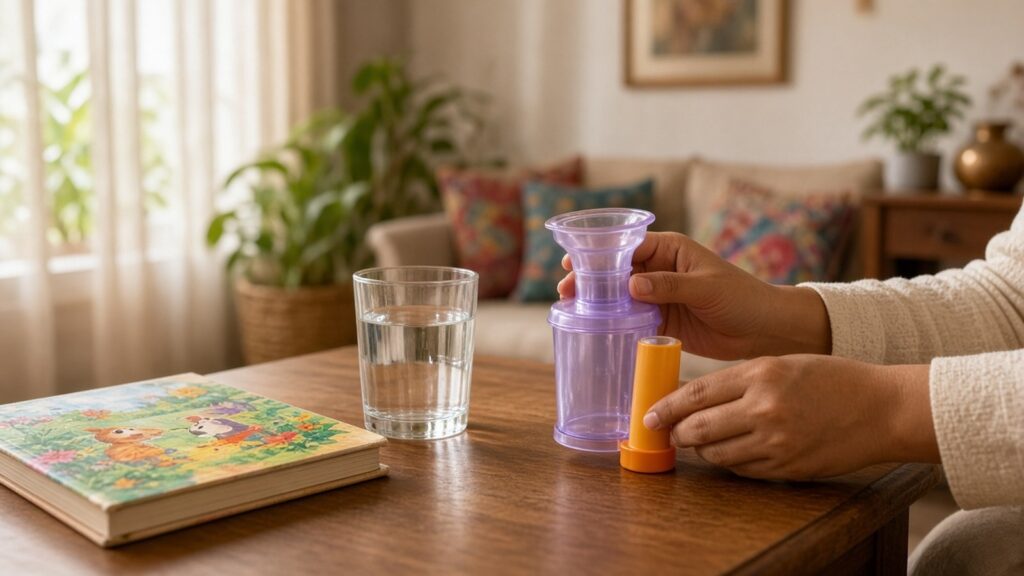
If inhaler time has become a daily argument, you are not alone. Many Indian parents describe tears, clenched jaws, running away from the spacer, or a child who suddenly needs water, the toilet or a cartoon the moment the medicine appears. This guide focuses on a calmer child inhaler routine: behaviour, timing and practice habits that reduce battles without changing any doses.
You will find ways to prepare the room, involve your child, use play without turning medicine into a joke, handle grandparents and school mornings, and know when refusal needs a clinician’s help. It is caregiver support, not a prescription.
This article is general education, not medical advice. Every child’s asthma is different. Please talk to a doctor about individual symptoms and treatment, and never start, stop or change any asthma medicine based on a blog post.
1. Why inhaler time turns into a battle
Children rarely refuse medicine to be difficult for its own sake. The mask can feel strange on the face. The noise of a spacer valve can scare a toddler. A rushed school morning makes everyone tense. A previous coughing fit during a dose can create fear the next day.
Common fuel for daily fights:
- Starting the routine only when you are already late.
- Different adults using different steps each time.
- Forcing the mask tightly when the child is crying hard.
- Offering big bribes that teach delay as a strategy.
- Talking only about illness and danger instead of a short, predictable ritual.
- Practising only when the child is already wheezy and frightened.
Technique still matters, and calm cooperation makes good technique more likely. For device basics, see our spacer 101 guide and our checklist of common inhaler technique errors. This article stays on the refusal and routine side.
2. Build a predictable ritual, not a surprise event
Children cooperate more when inhaler time looks the same most days. Predictability lowers fear.
- Same place. A chair by a window, a bedroom stool or a living-room corner becomes the medicine spot.
- Same short script. Two or three calm sentences you repeat: wash hands, sit, mask, breaths, done.
- Same order. If you brush teeth after the evening dose, keep that order. Rituals beat speeches.
- Visible timer for older kids. A one-minute sand timer or phone timer can make the end feel real.
- No surprise attacks. Do not chase a playing child across rooms with a mask. Call them to the spot first.
If mornings are chaos, shift practice to a calmer weekend slot until the steps feel familiar, while still giving prescribed doses as your doctor directed. Ask your clinician how to handle truly missed doses rather than guessing.
3. Practice when your child is well
The worst time to teach spacer skills is during an acute scare. Short, playful practice on good days builds muscle memory.
- Let your child handle a clean practice spacer or mask during quiet play while you supervise.
- Practise sitting still and counting breaths with the mask on the face for a few seconds, then longer.
- Use a stuffed toy first: “Teddy takes three calm breaths, then you.”
- Praise specific effort: “You kept the mask still for four breaths,” not vague “good boy” only.
- Stop practice before frustration peaks. End on a small success.
Age-appropriate explanations help too. Our parent guide on how to explain asthma to your child offers language that informs without fright.
4. Reduce sensory overload around the dose
Some refusals are sensory, not behavioural defiance. Soften the experience where you safely can.
- Warm the mask briefly in your hands so cold plastic is less startling.
- Let the child choose a sticker on the spacer case, not on the medicine canister in a way that blocks labels.
- Offer a favourite sitting cushion at the medicine spot.
- Lower your own voice. Adults who sound panicked make masks feel like danger.
- Avoid spraying perfume or lighting incense right before mask time.
- If the mask smell bothers them after washing, rinse thoroughly and air-dry as your device instructions suggest.
5. Cooperation tools that usually help (and a few that backfire)
Often helpful
- Two real choices that both lead to the dose: “Do you want to sit on the chair or on my lap for medicine?”
- A first-then board: first inhaler, then two pages of a book.
- Counting breaths together out loud in a calm rhythm.
- A simple sticker chart for completed routines, not for perfect mood.
- One parent leading while the other stays quietly supportive, instead of both giving instructions.
Often unhelpful
- Long lectures about hospitals during the thirty seconds of dosing.
- Threatening to cancel every festival if they refuse once.
- Forcing a screaming child’s face into a mask for prolonged periods without clinical guidance on distress dosing.
- Inconsistent rules between mother, father and grandparents in the same week.
- Hidden doses in food as a first strategy without clinician advice; trust matters.
Fathers and other caregivers need the same playbook. See how fathers can support children with asthma for shared-responsibility ideas.
6. Toddlers, preschoolers and school-age tweaks
The same asthma plan can need different cooperation styles as children grow.
- Toddlers: Keep sessions fast, use lap holding if that feels secure, distract with a song you only sing at medicine time, and practise mask touches during play.
- Preschoolers: Offer tiny jobs such as bringing the spacer pouch. Use story language: “The shield helps your breathing dragons stay calm.”
- School-age: Explain the why in plain words, let them track stickers, and rehearse school-bag packing so medicine feels ordinary, not secretive.
- Tweens: Respect privacy, agree reminders together, and shift toward supervised independence without abandoning check-ins.
For a wider childhood asthma overview, browse helping your child breathe easy. If colds bring fresh wheeze questions, our note on child wheezing with a cold can sit beside your clinician’s advice.
7. Grandparents, domestic help and school mornings
Battles multiply when every adult improvises. Write the routine down and stick it near the medicine spot.
- One-page steps with pictures for younger kids and helpers who prefer visual cues.
- Agree who leads morning doses on school days so the child is not negotiated with by three people.
- Pack the school inhaler separately from the home spacer if that prevents last-minute hunting.
- Tell helpers what not to do: no incense before doses, no skipping because the child looks fine.
- Thank consistency more than heroics. Quiet daily success beats dramatic rescue stories.
8. When refusal means you should call the doctor
Persistent refusal is a clinical problem as well as a parenting one. Contact your child’s doctor if:
- Doses are regularly missed because of fights.
- Distress during mask time is extreme or worsening.
- You are unsure whether technique is working when the child cries.
- Symptoms are increasing despite your best routine efforts.
- You feel close to using force and hate how medicine time feels.
Ask about spacer fit, mask size, timing tricks the clinic recommends, and whether a nurse educator session would help. Do not change the prescribed medicine schedule on your own.
Call 112 or go to the nearest emergency department if your child has severe breathlessness, cannot speak or cry as usual, has blue or grey lips, or their reliever is not helping. Routine battles are stressful; emergencies are different and need immediate care.
9. A seven-day reset plan for exhausted parents
If every night is a war, try a structured reset while following medical advice on actual dosing:
- Day 1: Write the exact steps on paper. Remove competing noise and incense from the medicine spot.
- Day 2: Practise mask-on-face for five calm seconds during play, no medicine required for that drill.
- Day 3: Align all caregivers on the same script.
- Day 4: Add a tiny choice and a sticker for completed doses.
- Day 5: Film yourself (privately) to check if your voice sounds rushed or angry; adjust tone.
- Day 6: Celebrate a smoother session with non-food connection time, such as a short game.
- Day 7: Review what still fails and message the clinic with specific questions.
Progress is often uneven. One hard morning does not erase a week of better habits.
10. Looking after yourself during the conflict
Parents who feel judged make louder medicine times. You are allowed to find this hard.
- Take three slow breaths before you call the child for the dose.
- Swap who leads if one adult is already depleted that evening.
- Avoid comparing your child’s cooperation to a cousin’s viral video of perfect inhaler use.
- Ask your paediatric team for educator support rather than only more instructions online.
- Protect a short adult pause after a rough session so resentment does not spill into bedtime.
11. Night doses, travel nights and festival disruption
Routines slip when dinner runs late, guests fill the living room or you sleep at a relative’s house. Plan the disruption instead of hoping the child will cooperate in a strange room.
- Pack the spacer and inhaler in a labelled pouch before you leave home, not while shoes are going on.
- Recreate the same short script even if the chair is different.
- Ask hosts for a quieter corner for two minutes; you do not need a full bedroom takeover.
- On Diwali nights, finish medicine before crackers peak if evenings get noisy and smoky.
- If a dose is missed because of travel chaos, contact your doctor for guidance rather than doubling up on your own.
Children read adult urgency. When festival noise rises, your calm ritual becomes the familiar island. That matters more than a perfect Instagram-ready technique video.
Siddhant’s POV: Calm routines beat perfect speeches
I have lived with asthma for more than 30 years, so I know medicine can feel like a burden long before a child has words for it. My breathing improved after I moved from Delhi NCR to Dehradun, and that change reminded me how much environment and daily habits shape comfort. Watching families struggle at inhaler time, I notice the same truth: rushed adults create rushed children.
A short ritual, a steady voice and help from the doctor when refusal sticks will do more than a long lecture. You are teaching care, not winning a contest.
Siddhant Jain, founder of Asthma Friend, has lived with asthma for more than 30 years.
Conclusion
A child inhaler routine becomes less of a battle when it is predictable, practised on calm days, supported by every caregiver the same way, and backed by clinical help when refusal persists. Soften the sensory experience, offer tiny choices, drop threats that teach delay, and treat emergencies as emergencies. You do not need perfect behaviour. You need repeatable steps that get medicine in with as little fear as possible, under your doctor’s plan.
Take the next step with Asthma Friend
- Join our community: Connect with people who understand life with asthma at Asthma Friend.
- Learn through play: Explore free educational games at Asthma Friend Games.
- Create your free asthma action plan: Use the Asthma Friend Action Plan Generator and keep a copy handy through the festive season.
Frequently asked questions
Use the same place, same short script and same order each day. Practise the mask on calm days, offer tiny choices, keep your voice steady and involve all caregivers in one plan.
Strange texture, cold plastic, noise, rushed mornings and fear after a previous coughing fit are common reasons. Sensory tweaks and playful practice often help more than longer lectures.
Forcing through extreme distress can increase fear and may worsen cooperation long term. Ask your doctor or nurse educator for guidance on distressed dosing and technique checks.
Simple sticker charts and first-then routines usually work better than huge bribes. Praise specific effort, such as keeping the mask still for counted breaths.
Give them a one-page step list, agree who leads each dose, and ask them not to skip medicine because the child looks fine or to add incense before mask time.
Call if doses are regularly missed, distress is extreme, technique seems unreliable during tears, symptoms are rising, or you feel close to using force.
Call 112 or go to the nearest emergency department for severe breathlessness, inability to speak or cry as usual, blue or grey lips, or a reliever that is not helping.
Last reviewed: 1 November 2026
Information on this page was written against widely published guidance from national and international respiratory health bodies. It is educational only and is not a substitute for personal medical advice from a doctor.

About the author
Siddhant Jain
Siddhant Jain is the founder of Asthma Friend. He has lived with asthma for more than 30 years. After moving from Delhi NCR to Dehradun, his breathing improved, and he built Asthma Friend to give Indian patients and caregivers practical, empathetic education. The content is educational and is not a substitute for advice from a doctor.
Related posts:
 Diwali Shopping in Crowded Markets with Asthma: Dust, Traffic Fumes and Crowd Planning
 The Ultimate Guide to Managing Asthma During Seasonal Changes
 Why Occasional Smoking or Hookah Is Dangerous Especially If You Have Asthma
 What to Keep in Your Work Bag If You Have Asthma: A Practical Checklist
 Workplace Stress: The Hidden Trigger Behind Asthma and High Blood Pressure
 Ride Smells & Sprays: How to Handle Fragrances in Autos, Taxis, and Rideshares
 Pest Control Safely: Low-Smell Options & Precautions for Asthma Patients in India
 Visiting Homes with Pets When You Have Asthma: Planning Without Blame
 How to Recognize Early Signs of an Asthma Attack
 World Asthma Day 2025: Breathing Life into Awareness, One Story at a Time