
From October to February, many families in North India start the day by checking the air. The sky can look milky, a morning walk can feel unwise, and a tight chest can make ordinary errands feel heavier. If you live with asthma, or look after someone who does, smog season asks for a little extra planning, not panic.
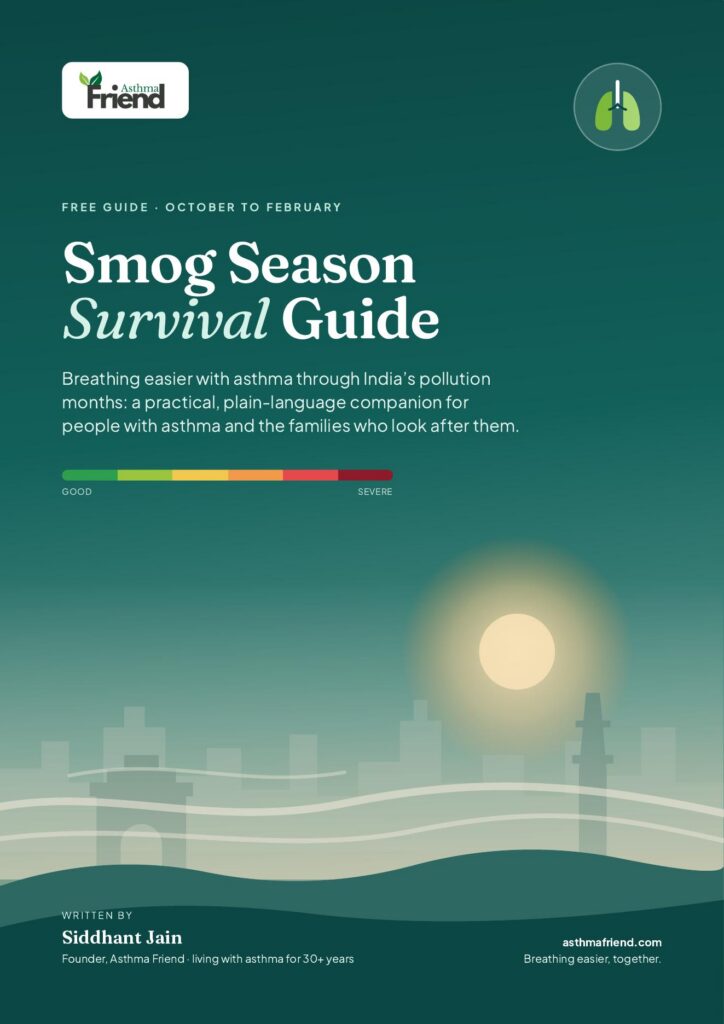
This article is a practical quick-start for those months. The tips below stand on their own. For the full colour-coded AQI table, printable checklists, a school note and an emergency card, you can also download Asthma Friend’s free 27-page Smog Season Survival Guide.
This article is general education, not medical advice. It does not diagnose, treat or cure anything, and it does not replace advice from your own doctor or emergency care. Always follow the asthma action plan your doctor has given you, and talk to your doctor before starting, stopping or changing any medicine. If breathing is getting worse quickly, call 112 or 108, or go to the nearest emergency department straight away.
1. Why smog season is harder when you have asthma
Asthma means your airways are sensitive and can swell, tighten and fill with mucus. Polluted air is one of the things that can set that off. Some particles in smog, often called PM2.5, are small enough to travel deep into the lungs. You cannot always see them, so a clear-looking morning can still be a high-AQI day. Trust the number, not the view from the window.
In these months, vehicle exhaust, road dust, construction, crop residue burning, firecrackers, burning of garbage or leaves, and smoke from cooking or heating can pile up at once. Indoors, incense, mosquito coils, cigarettes, bidis and sprays can add to the load, so closing the door does not automatically mean clean air. People with asthma may feel this more quickly, along with young children, older people and pregnant women. Symptoms can also rise a day or more after a high-AQI day, so a simple two-week note of the AQI and how you feel is a useful thing to show your doctor.
2. A simple way to use the Indian AQI
The Indian AQI turns several pollutants into one number and colour. The worst pollutant sets the reading. Here is a practical way to use the bands, as set out in our free guide. For a fuller walkthrough, see our article on Asthma and India’s AQI in stubble season.
- Good, 0 to 50: a normal routine day, and a better moment to air the house.
- Satisfactory, 51 to 100: carry your reliever as always, and notice how you feel during long or hard exercise outdoors.
- Moderate, 101 to 200: avoid prolonged or strenuous outdoor exercise, move workouts indoors, and start your bad-air routine.
- Poor, 201 to 300: avoid outdoor physical activity, keep windows shut in the morning and late evening, and wear a well-fitted mask for necessary trips.
- Very Poor, 301 to 400: stay indoors as much as you can, keep activity low, run your purifier if you have one, and follow your action plan closely.
- Severe, 401 to 500: stay indoors, postpone non-essential trips, and contact your doctor early if symptoms rise.
Do not wait until the air is Poor. Agree your personal trigger point with your doctor, and use the official reading for the station nearest your home, school or office, not only a city average.
3. A daily routine for bad-air days
On days when the AQI is Moderate or worse, a simple routine takes the guesswork out. You can stick a short version on the fridge.
- Wake up: check the AQI and how your chest feels. Take your regular medicines exactly as prescribed, and note peak flow if your doctor has asked you to.
- Morning: on Poor to Severe days, keep outer doors and windows shut, and skip the morning walk or jog.
- Heading out: keep your reliever, and a spacer if you use one, in your bag. Wear a well-fitted N95 or equivalent for longer trips, and choose routes away from slow, heavy traffic.
- Midday: if you need to air the house, a short window between 12 and 4 pm is often the better time. Check the AQI first and keep it brief.
- Evening and night: avoid late-evening outdoor exercise. If you have a purifier, run it in the bedroom with the door closed, and note the AQI and your symptoms in a simple tracker.
Drink enough water, wet-mop instead of sweeping, and check that you have enough medicine for the week. If you need your reliever more than usual, or symptoms wake you at night, follow your action plan and contact your doctor. If breathing is getting worse quickly, call 112 or 108, or go to emergency care now.
4. Make one room a clean-air zone
Start with the room you sleep in. On Poor to Severe days, keep outer doors and windows closed in the morning and late evening. If you use an air conditioner, set it to recirculate so it does not pull in outside air. Our guide on closing windows on smog days without trapping stale air explains how to ventilate more carefully.
Wet-mop floors and wipe surfaces with a damp cloth, and use a chimney or exhaust fan when you cook. Where you can, use cleaner fuels such as LPG or electricity rather than wood, coal or kerosene. Keep incense brief and away from the person with asthma, and prefer mosquito nets or screens over coils.
If you use a purifier, look for a true HEPA filter, a clean air delivery rate that fits the room, and no ozone. Keep that room closed while it runs, and replace filters as the maker instructs. A purifier is not a reason to change your medicines, and a few houseplants will not clean the air in a flat. Our guide on choosing an air purifier for an Indian home covers HEPA, room size and a winter setup.
5. Masks for the trips you still need to make
Use a certified N95 or N99 respirator, or an equivalent such as FFP2, with the standard printed on the mask itself. A paper mask, handkerchief, scarf, dupatta or ordinary cloth mask will not filter smog well enough. Choose two head straps rather than ear loops, cover your nose and chin with no side gaps, and do the seal check in the pack instructions each time. Beards reduce protection. Our article on picking an N95 you can actually breathe in has more detail.
Masks and respirators should not be worn by children under 2. For older children, a mask only helps if it fits, does not block vision, and they will keep it on. Most certified sizes are designed for adults, so cleaner indoor air matters more for young children. If you live with asthma, ask your doctor before using a respirator for longer periods. If you feel breathless, dizzy or unwell in a mask, move to cleaner air and take it off. If symptoms do not settle, get medical help.
6. Going out, exercise and the commute
On bad-air days, move activity indoors rather than dropping it, and avoid strenuous outdoor exercise when pollution is high. On Poor to Severe days, skip morning and late-evening walks, runs and jogs. Ask your doctor whether to use your reliever before exercise. Do not decide this alone. Bunch errands into one trip, go when the hourly AQI is lower if you can, and avoid slow traffic and construction sites.
- By car: keep windows up, set the air conditioner to recirculate, and keep the car smoke-free.
- By metro or bus: wear a well-fitted N95 for the walk to the station and on crowded platforms, and keep your reliever in an easy-reach pocket.
- By two-wheeler, auto or on foot: wear a well-sealed N95 where you can, and pick quieter lanes even if they take a little longer.
If you drop children at school, park a little away from the gate and avoid waiting with the engine running.
7. Children, school, and the weeks around Diwali
Watch for a cough that is worse at night or after play, wheezing, getting out of breath sooner than friends, a chest that feels tight or funny, or needing the reliever more often than usual. If you notice these, follow your child’s action plan and speak to their doctor. On Moderate days and above, swap long, hard outdoor play for shorter, gentler play, and keep their reliever and spacer with them, not only in a staff room.
Share a written action plan with the class teacher and the school office, ask whether PE and outdoor assemblies move indoors on high-AQI days, and ask your doctor whether a spare reliever should stay at school. The free guide includes a short, fill-in note you can hand to a teacher.
Around Diwali and the crop-burning weeks, several pollution sources can peak together. Our article on celebrating Diwali more safely when fireworks and smoke fill the air goes deeper on festival days. Two weeks before, review your action plan with your doctor, check medicine stock, and save emergency numbers. On festival days, stay in your clean-air room when crackers start, choose diyas, lights, rangoli and sweets over crackers, and keep the reliever within reach. In the days after, remember that symptoms can rise a day or more later, ease back outdoors only as the AQI improves, and call your doctor if reliever use rises. If you are travelling home, pack medicines in your hand luggage, carry a copy of your action plan, and look up the nearest hospital at your destination before you go.
8. Work with your doctor before the worst weeks
The most useful preparation is a written, doctor-reviewed asthma action plan. Review it early in the season, not the night the AQI spikes. Our guide on how to develop an asthma action plan explains the idea. A written plan usually covers a green zone for everyday care, a yellow zone for when symptoms worsen, and a red zone for emergency steps, including when to call 108 or 112.
Ask whether your plan should change on high-AQI days, whether your inhaler technique needs a check, whether a spacer would help, whether you should track peak flow, whether it is safe for you to wear an N95 for longer periods, and whether you should keep a spare reliever at school, work or in the car. Please do not increase, reduce or stop any medicine on your own because the AQI is high. Keep taking your prescribed medicines even when you feel well, unless your doctor tells you otherwise. You can use Asthma Friend’s free action plan tool at plan.asthmafriend.com to organise a draft plan. Your doctor must review and fill in the medical parts.
9. Know the red flags and act early
Follow your written action plan straight away if symptoms are getting worse quickly, if your reliever is not helping as much as usual or you need it more often, if walking or talking is difficult, or if your peak flow is much lower than usual, if you are asked to track it. The free guide has a printable emergency card you can keep in a wallet or school bag.
Get help now if you can speak only in words, not full sentences; if you are drowsy, confused or very agitated; if lips or fingertips look blue or grey; if a child cannot speak or drink; or if things are getting worse, or the reliever is not helping as your plan says it should. Call 108 or 112. Sit up straight, use your reliever exactly as your plan says for an attack, and move away from smoke or polluted air if you can. Do not drive yourself to hospital. Take your action plan, medicines and a phone with you. Even if you recover, see a doctor soon after an attack, ideally within two days. If in doubt, get help.
10. Download the free Smog Season Survival Guide
The tips above are a quick-start. The Smog Season Survival Guide puts them in one calm, printable place you can keep on your phone or on the fridge. It is a free 27-page PDF, first published in November 2026, written by Siddhant Jain, founder of Asthma Friend. It is free to share in full for non-commercial use. You do not need to read it cover to cover. Dip in when the AQI turns. Inside you will find:
- a colour-coded table of the Indian AQI bands, with a practical column for people with asthma
- a daily routine for bad-air days
- how to make your home a clean-air zone, and what to look for in a purifier
- masks that actually filter smog, and how to get a good seal
- advice on going out, exercise and the commute
- guidance for children with asthma, plus a printable note for school
- a plan for festival and stubble-burning weeks
- questions to take to your doctor, and a reminder not to change medicines on your own
- warning signs, emergency steps, and a fill-in emergency card
- a short myths versus facts section
- printable tools: a pre-season checklist, a home clean-air audit, and a daily AQI and symptom tracker to take to your doctor
If you only do one thing after reading this, book a visit with your doctor and ask for a written asthma action plan for the season. Everything else works best on top of that.
You can also open the guide directly at https://asthmafriend.com/wp-content/uploads/2026/11/pollution-season-guide.pdf.
Siddhant’s POV: One calm plan for the smog months
I have lived with asthma for more than 30 years, and my breathing improved after I moved from Delhi NCR to Dehradun. That contrast is why a practical plan for the smog months matters so much to me.
My view is that small, sensible habits, a written plan from your doctor, and a clear emergency plan help more than waiting for the air to clear. The free guide is my attempt to put those pieces in one place that families can actually use. Please treat it as a companion to your doctor, never a substitute.
Siddhant Jain, founder of Asthma Friend, has lived with asthma for more than 30 years.
Conclusion
Smog season in North India, from October to February, asks people with asthma for a little extra care. Use the official AQI for your nearest station, start a bad-air routine from the Moderate band unless your doctor suggests otherwise, and make one room a clean-air zone. Wear a well-fitted N95 or equivalent for necessary trips, move exercise indoors on poor-air days, and plan ahead for school, Diwali and stubble-burning weeks. Review a written action plan with your doctor, and do not change medicines on your own. Download the free 27-page Smog Season Survival Guide for the colour-coded table, checklists and emergency card. If breathing is getting worse quickly, call 112 or 108, or go to the nearest emergency department.
Take the next step with Asthma Friend
- Join our community: Connect with people who understand life with asthma at Asthma Friend.
- Learn through play: Explore free educational games at Asthma Friend Games.
- Create your free asthma action plan: Use the Asthma Friend Action Plan Generator and keep a copy where you and your family can find it.
Frequently asked questions
It is Asthma Friend’s free 27-page PDF for people with asthma and their families during India’s October to February pollution months. It offers practical tips, checklists and an emergency card, and it does not replace your doctor’s advice.
Yes. It is free to download, and it is free to share in full for non-commercial use.
It includes a colour-coded Indian AQI table, a daily routine for bad-air days, clean-air-at-home advice, mask guidance, tips for children and school, plans for Diwali and stubble-burning weeks, questions for your doctor, warning signs, and printable checklists, a tracker and an emergency card.
No. It is general education and support. Always follow the plan your doctor has given you, and talk to your doctor before starting, stopping or changing any medicine.
A practical starting point is the Moderate AQI band, unless your doctor has agreed a different trigger point with you. Do not wait until the air is Poor.
Follow the emergency steps in your written action plan. If breathing is getting worse quickly, call 112 or 108, or go to the nearest emergency department. Do not drive yourself to hospital.
It was written by Siddhant Jain, founder of Asthma Friend, for people with asthma in India and the families who look after them. It is a companion for the smog months, not a substitute for clinical care.
Free: Smog Season Survival Guide
A practical 27-page guide to breathing easier with asthma through India's pollution months: AQI explained, clean air at home, masks, kids and school, plus printable checklists. Join the free Asthma Friend newsletter and we'll email it to you.


Last reviewed: 15 November 2026
Information on this page was written against widely published guidance from national and international respiratory health bodies. It is educational only and is not a substitute for personal medical advice from a doctor.

About the author
Siddhant Jain
Siddhant Jain is the founder of Asthma Friend. He has lived with asthma for more than 30 years. After moving from Delhi NCR to Dehradun, his breathing improved, and he built Asthma Friend to give Indian patients and caregivers practical, empathetic education. The content is educational and is not a substitute for advice from a doctor.
Related posts:
 Asthma and Sinus Problems: Understanding the Connection Without Self-Diagnosing
 Why a Cough May Linger After a Cold and When to Seek Care
 Can Diwali Cleaning Trigger Asthma? How to Do Your Safai Without Dust, Mould and Chemical Fumes
 Flying with Asthma from India: Inhalers in Hand Baggage, Airport Security and Dry Cabin Air
 Setting Boundaries with Smokers in the Family: Protecting Yourself from Asthma Triggers
 Asthma and Train Travel in India: A Preparation Checklist for Sleeper and AC Coaches
 How to Create an Asthma-Friendly Home: Tips for Reducing Triggers
 Renovating? Low-VOC Paints and Safer Home Upgrades for Asthma-Friendly Homes
 Rangoli Colours and Asthma: Are Powders and Chalk Dust a Trigger?
 How Intermittent Fasting Affects Asthma: Benefits, Risks, and Considerations