
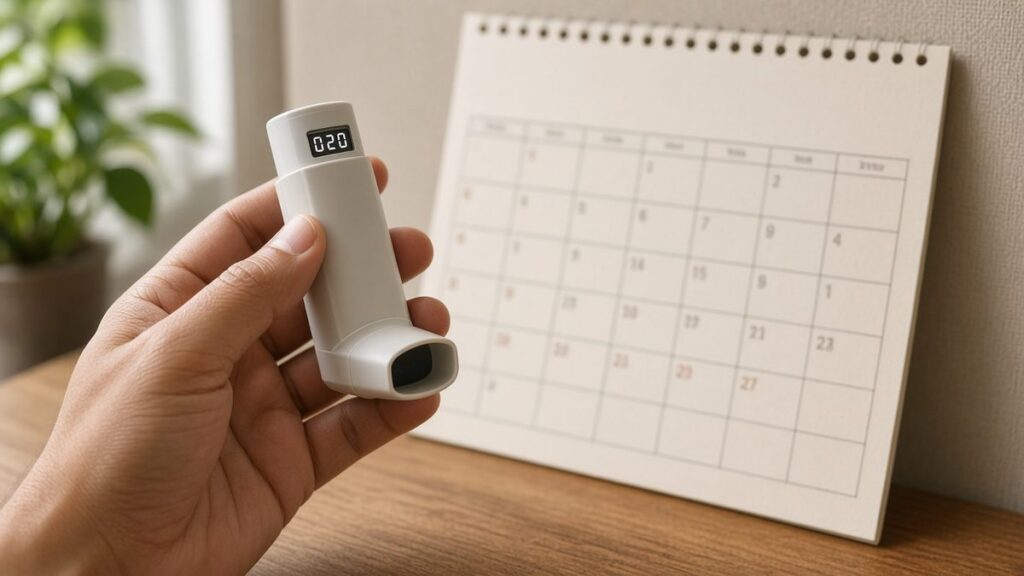
Most of us only think about our inhaler when we need it. That is exactly when finding out it is empty, or long past its expiry date, is the worst possible surprise. Many inhalers can still make a puffing sound or release a little spray even when the number of full doses has run out, so the feeling of “it still works” can be misleading.
The good news is that a simple monthly habit can prevent most of these surprises. This guide explains how to read an inhaler expiry date, how dose counters work, why the old shake and float tests are not reliable, and how to build a quick check into your routine.
This article is general education, not medical advice. Please follow the instructions that come with your inhaler and the advice of your doctor or pharmacist. Never start, stop or change any asthma medicine on your own. If you are struggling to breathe, call 112 immediately.
1. Why running out or using an expired inhaler matters
An inhaler is a measured device. It is designed to give a set number of doses, each with a specific amount of medicine. After that number, some devices may still spray propellant with little or no medicine in it. If you are relying on a reliever during an attack and it is effectively empty, you may not get the help you expect.
Expiry dates matter too. Manufacturers test how long the medicine stays stable and effective in its packaging, and the expiry date reflects that. Using a device past its date means you cannot be sure it will work as intended.
2. How to read an inhaler expiry date
2.1 Where to look
The expiry date is usually printed in two places:
- on the outer carton, often near the batch number
- on the inhaler canister or device itself, sometimes in small embossed or printed text
On many canisters it is printed as “EXP” followed by a month and year. If it shows only a month and year, the medicine is generally considered usable until the end of that month, but check the leaflet or ask your pharmacist if you are unsure.
2.2 “Use within” dates after opening
Some inhalers have a second limit: they must be used within a certain number of weeks or months after you open the foil pouch or start using them, even if the printed expiry is later. This is common with some dry powder inhalers. The leaflet will tell you if this applies.
- When you open a new device, write the opening date on it with a marker.
- Note the “use by” date on the device or in your phone.
2.3 Check at the chemist counter
When you buy a new inhaler, look at the expiry date before you leave the shop. A short-dated device may run out of date before you finish it. You can politely ask for a fresher stock if needed.
3. Understanding the dose counter
3.1 What a dose counter is
Many modern inhalers have a small window that shows how many doses are left. Some count down one by one, others in steps of ten or twenty. Some change colour, often to red, when the device is nearly empty.
- Look at the counter when you start a new device so you know the starting number.
- Check what the leaflet says about when to get a replacement, often when the counter reaches a certain number or turns red.
- When the counter reaches zero, stop relying on that device, even if it still seems to spray.
3.2 If your inhaler has no counter
Some inhalers do not have a counter. In that case, you can keep track yourself:
- Find the total number of doses on the label or carton.
- Work out how many puffs you use a day, including any extra reliever doses.
- Divide the total by the daily puffs to estimate how many days the device will last.
- Write the expected end date on the device and in your phone calendar.
For reliever inhalers that you use only sometimes, a tally on a small sticker or a note in your phone each time you use it can help.
3.3 Practice puffs and priming
Some inhalers need to be “primed” with test sprays when new or when they have not been used for a while. Those sprays use up doses too. Your leaflet will explain whether priming is needed and how many sprays to release. Count these in your tally.
4. Why the shake and float tests mislead
Many people were taught to shake an inhaler and listen for liquid, or to float the canister in water to see how full it is. These tests are not reliable.
- Shaking: a canister may still contain propellant and a little liquid even when the full measured doses have run out, so it can still sound or feel like there is something left.
- Floating: this was once common advice, but it is not accurate and water can get into the valve and affect how the device works. Most manufacturers advise against it.
The dose counter, or your own tally, is a much better guide. If you are unsure, ask your pharmacist to look at the device with you.
5. Storing inhalers through an Indian winter and summer
Temperature and moisture can affect inhalers. India has both: cold nights in the North in winter and very hot cars and bags in summer.
- Keep inhalers at room temperature, away from direct sunlight, heaters and stoves.
- Do not leave them in a parked car or on the dashboard.
- In very cold weather, some metered dose inhalers may not spray well if they are very cold. Follow the leaflet advice, which may suggest warming the canister in your hands before use.
- Keep dry powder inhalers away from moisture, and do not breathe into them.
Our guide on how to maintain your inhalers and spacers covers cleaning and general care in more detail.
6. The monthly inhaler check: a five-minute habit
Pick one fixed day each month, such as the first Sunday or the day your salary arrives. Set a phone reminder and go through this checklist:
- Gather every inhaler and spacer you have: home, work bag, car, school bag.
- Read the expiry date on each and note any that expire in the next two months.
- Read the dose counter or your tally on each device.
- Check the mouthpiece for dust or blockage, and look at the spacer for cracks.
- Note anything that needs replacing, and ask your doctor or pharmacist about a refill if needed.
- Put each inhaler back in its proper place.
If you keep spares in different bags, the monthly check is a good time to make sure each one is still in date. Our asthma work bag essentials list can help you plan what goes where, and our guide to creating an asthma emergency kit for your home explains what to keep at home.
7. Refill reminders that actually work
- Phone calendar: set a reminder a week or two before your expected end date.
- Pharmacy routine: some local chemists will set aside your regular inhaler if you tell them when you usually come.
- Family support: in joint families, one person can keep a simple list of everyone’s medicines and dates.
- Prescription check: make sure your prescription is current, especially if your doctor wants to review you before renewal.
8. Controller and reliever: why both need checking
People often watch their reliever closely but forget the daily controller, or the other way around. Both matter. If you are not sure which inhaler is which, read our explainer on controller vs reliever inhalers and ask your doctor to confirm your plan.
If you find you are using your reliever much more than usual, or running out faster than before, do not just buy more and carry on. That can be a sign your asthma is not well controlled. Talk to your doctor.
9. Technique still matters
Even a full, in-date inhaler will not help much if the medicine does not reach your lungs. If you have not had your technique checked in a while, our guide on inhaler technique fixes covers common errors, and your doctor or pharmacist can watch you use it.
10. When to seek medical help
Call 112 or go to the nearest emergency department if:
- you are very breathless, cannot speak in full sentences or are struggling to breathe
- your reliever is not helping or the relief does not last
- your lips or fingertips look blue or grey
Siddhant’s POV: Small checks deserve a place in the plan
I have lived with asthma for more than 30 years. My breathing improved after I moved from Delhi NCR to Dehradun.
My view is that checking an inhaler should be treated as a practical task, not a test of memory. I would encourage readers to ask a pharmacist how their device shows remaining doses, where to find its expiry date and how to store it safely. I believe a regular reminder is worth discussing, so questions about replacement can be sorted before the device is needed.
Siddhant Jain, founder of Asthma Friend, has lived with asthma for more than 30 years.
Conclusion
Checking an inhaler’s expiry date and dose counter takes a few minutes a month and can save you from a frightening moment. Read the printed expiry and any “use within” date, rely on the dose counter or your own tally instead of shaking or floating, store devices away from heat and moisture, and set a monthly reminder to check every inhaler you own. If you are using more reliever than before, talk to your doctor, and in an emergency call 112.
Take the next step with Asthma Friend
- Join our community: Connect with people who understand life with asthma at Asthma Friend.
- Learn through play: Explore free educational games at Asthma Friend Games.
- Create your free asthma action plan: Use the Asthma Friend Action Plan Generator and keep a copy where you and your family can find it.
Frequently asked questions
Check the dose counter if your inhaler has one, or keep a tally of puffs against the total number of doses on the label. A device can still spray after the measured doses are used up, so do not rely on sound or feel.
It is best not to rely on an expired inhaler, as the manufacturer cannot assure it will work as intended. Ask your pharmacist or doctor about a replacement.
No. The float test is not reliable and water may affect the valve. Use the dose counter or a puff tally instead.
It is usually printed on the outer carton and on the canister or device itself, often marked EXP with a month and year.
Keep it at room temperature, away from heaters and direct sunlight, and follow the leaflet if it advises warming a cold canister in your hands before use.
Talk to your doctor. Needing your reliever more often can be a sign that your asthma is not well controlled.

Free: Smog Season Survival Guide
A practical 27-page guide to breathing easier with asthma through India's pollution months: AQI explained, clean air at home, masks, kids and school, plus printable checklists. Join the free Asthma Friend newsletter and we'll email it to you.


Last reviewed: 8 November 2026
Information on this page was written against widely published guidance from national and international respiratory health bodies. It is educational only and is not a substitute for personal medical advice from a doctor.

About the author
Siddhant Jain
Siddhant Jain is the founder of Asthma Friend. He has lived with asthma for more than 30 years. After moving from Delhi NCR to Dehradun, his breathing improved, and he built Asthma Friend to give Indian patients and caregivers practical, empathetic education. The content is educational and is not a substitute for advice from a doctor.