
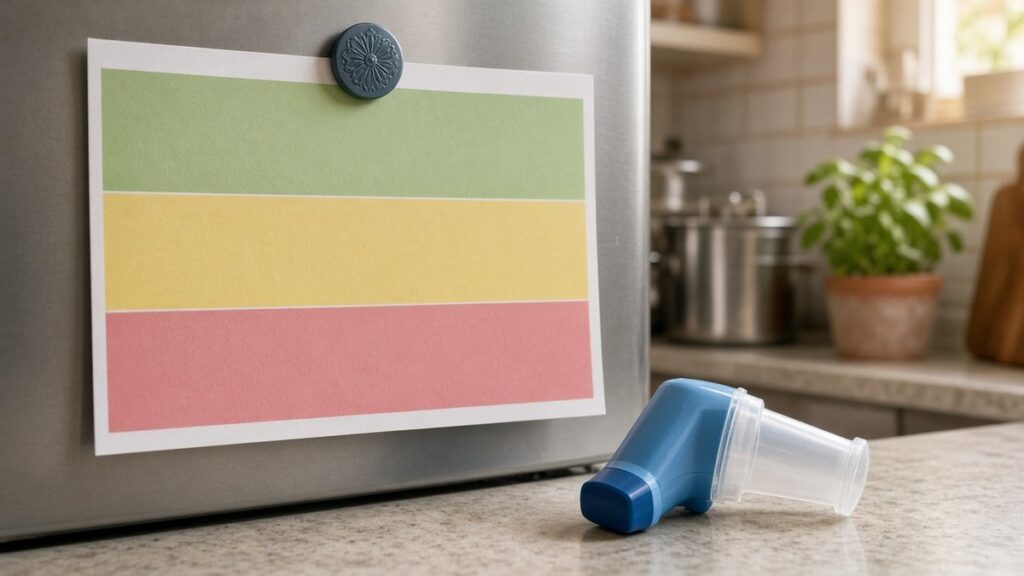
If you have ever been handed an asthma action plan, you have probably seen three coloured bands: green, yellow and red. It looks simple, and that is the point. When you are coughing at 2 am or your child is wheezing before school, nobody wants to read a long letter. A traffic light tells you, at a glance, how worried to be and what to do next.
But many families in India either never get a written plan, or get one and leave it in a file. The colours only help if everyone at home understands what each zone means for this particular person. This guide walks through the three zones in plain language, explains how people usually work out which zone they are in, and shows how to turn a general template into something that truly fits you.
This article is general education, not medical advice. Your own action plan should be written with your doctor, and only your doctor should decide which medicines and doses go into each zone. Never start, stop or change asthma medicine on your own. If someone is struggling to breathe, call 112 immediately.
1. Why action plans use a traffic light
Asthma changes from day to day. Smog, cold air, a viral cold, stress or a dusty cupboard can tip a good week into a difficult one. An action plan turns those changes into clear steps. The traffic light idea works because almost everyone already knows it:
- Green means carry on as usual
- Yellow means slow down, pay attention and act early
- Red means stop and get help now
Children understand it. Grandparents understand it. A driver, a teacher or a neighbour can understand it in a few seconds. That is why the same three colours appear on most asthma action plans, including the free template on the Asthma Friend Action Plan Generator.
If you are starting from scratch, our older guide on how to develop an asthma action plan gives the big picture. This post goes deeper into the zones themselves.
2. The green zone: doing well
The green zone describes what your asthma looks like when it is under good control. Typical green zone descriptions include:
- breathing feels easy
- no cough, wheeze or chest tightness, or only very occasional symptoms
- sleeping through the night without waking because of asthma
- able to work, study, play and exercise normally
The green zone is not a holiday from asthma care. It usually lists the everyday medicines your doctor has prescribed, often a preventer or controller, and anything to do before exercise or known triggers. Staying in green often depends on taking those medicines as prescribed, even when you feel fine.
A useful question for your doctor: “What does green look like for me? Is an occasional cough still green, or is that already a sign to watch?”
3. The yellow zone: getting worse
The yellow zone is the most important and the most ignored. It covers the early warning signs that asthma is starting to slip. Common yellow zone signs include:
- more coughing, especially at night or early morning
- wheeze or a tight chest that keeps coming back
- needing your reliever more often than usual
- waking at night because of breathing
- feeling breathless with activities that are normally easy
- signs of a cold or chest infection that usually set off your asthma
Yellow is where an action plan earns its place. The plan should say exactly what your doctor wants you to do when these signs appear, how long to follow those steps, and when to call the clinic. Without a written plan, people in yellow tend to either panic or wait it out. Neither is ideal.
Our guide to recognising early signs of an asthma attack is a good companion to this section, because your own early signs may be quite different from the textbook list.
4. The red zone: medical alert
The red zone describes a serious flare that needs urgent help. Typical red zone signs include:
- severe breathlessness, or breathing that is getting worse quickly
- difficulty speaking in full sentences, walking or eating
- the reliever is not helping, or the relief lasts only a short time
- ribs or neck muscles pulling in with each breath
- lips, tongue or fingertips turning blue or grey
- drowsiness, confusion or exhaustion
The red zone section of a plan should list emergency steps from your doctor and emergency numbers. In India, 112 is the national emergency number and 108 is the ambulance number in many states. Many families also write down the nearest hospital with an emergency department.
Do not wait to be sure. If you think someone is in the red zone, call 112 and follow the emergency steps in the plan while help is on the way.
5. How people tell which zone they are in
Most plans use one or both of these:
5.1 Symptoms
This is the simplest method and works for everyone, including young children. You compare how the person is breathing, sleeping and coping today with the descriptions in each zone.
5.2 Peak flow readings
Some plans also use peak flow numbers. A peak flow meter measures how fast you can blow air out. Your doctor may use your personal best reading to set ranges for each zone. Not everyone needs a peak flow meter, and readings should always be read alongside symptoms, not instead of them. If your doctor suggests one, ask them to write the exact ranges into your plan.
5.3 When symptoms and numbers disagree
Sometimes a reading looks fine but you feel awful, or the other way round. Most doctors suggest going by the more worrying of the two and contacting them. Write this rule into your plan so nobody has to guess.
6. Making the zones personal
A generic plan says “cough”. A personal plan says “cough that wakes Riya more than once a night”. That level of detail is what makes the plan useful to a grandparent or teacher who does not know the person well.
When you sit down with your doctor, try to fill in:
- Your green: how you feel on a good day and which daily medicines you take
- Your early yellow signs: the first things that change for you, such as a dry evening cough or feeling tired climbing stairs
- Your yellow steps: what your doctor wants you to do, for how long, and when to call
- Your red signs: the signs that mean emergency for you
- Your red steps: emergency instructions, numbers and nearest hospital
- Your triggers: smoke, dust, cold air, pets or anything else you know affects you
You can put all of this into a clear, printable layout in about five minutes. Create your free asthma action plan with the Asthma Friend Action Plan Generator, then take it to your doctor so they can check and adjust every zone.
7. Common mistakes with the zones
- Treating yellow as green. Getting used to a nightly cough and calling it normal.
- Staying in yellow too long. Days of extra reliever use without telling the doctor.
- Waiting for red to feel “bad enough”. Hesitating to call 112 because you do not want to fuss.
- Using an old plan. Medicines change, children grow, and the plan stays the same.
- One copy only. A plan locked in a drawer cannot help anyone at school, work or a relative’s house.
Keeping a short record of symptoms makes it easier to spot when you are drifting from green to yellow. Our guide to an asthma diary that is actually easy to maintain has a simple format.
8. Teaching the zones to the whole family
Once your plan is ready, spend ten minutes going through it with the people around you:
- point to each colour and describe what it looks like in real life
- ask each person, “What would you do if you saw this?”
- show where the plan is kept and where the reliever and spacer live
- save emergency numbers on every phone at home
Children often enjoy turning this into a quiz. Ask, “Coughing all night: which colour?” and let them answer. For more ideas on talking to younger children, see our parent’s guide on how to explain asthma to your child.
Siddhant’s POV: The yellow zone deserves more respect
I have lived with asthma for more than 30 years, and my breathing improved after I moved from Delhi NCR to Dehradun. Even with cleaner air, I believe a written plan matters, because asthma can still change with seasons, infections and travel.
My view is that most of the value of an action plan sits in the yellow zone. Green is easy to recognise and red is frightening enough that people usually act. Yellow is where small signals get brushed aside. If you take one thing from this post, let it be this: write down your own early warning signs with your doctor, and agree in advance what you will do when they appear.
Siddhant Jain, founder of Asthma Friend, has lived with asthma for more than 30 years.
Conclusion
The green, yellow and red zones turn a complicated condition into three clear questions: am I doing well, am I getting worse, or do I need help now? A plan only works when each zone is written for the real person, checked by a doctor, and understood by everyone around them. Make your plan, review it at your next appointment, and keep copies where they will be seen.
Take the next step with Asthma Friend
- Join our community: Connect with people who understand life with asthma at Asthma Friend.
- Learn through play: Explore free educational games at Asthma Friend Games.
- Create your free asthma action plan: Use the Asthma Friend Action Plan Generator and keep a copy where you and your family can find it.
Frequently asked questions
Green means asthma is well controlled, yellow means symptoms are getting worse and early action is needed, and red means a serious flare that needs urgent medical help.
Your doctor should decide the medicines, doses and steps in each zone. You can prepare the plan with a free tool, but it should always be reviewed with your doctor.
Not always. Many plans use symptoms alone. If your doctor recommends peak flow monitoring, ask them to write the ranges for each zone into your plan.
Call 112 straight away and follow the emergency steps written in the plan while help is on the way. Do not wait to see if it settles.
Review it with your doctor at your regular asthma check-ups, after any flare that needed urgent care, and whenever medicines change.
Free: Smog Season Survival Guide
A practical 27-page guide to breathing easier with asthma through India's pollution months: AQI explained, clean air at home, masks, kids and school, plus printable checklists. Join the free Asthma Friend newsletter and we'll email it to you.


Last reviewed: 14 November 2026
Information on this page was written against widely published guidance from national and international respiratory health bodies. It is educational only and is not a substitute for personal medical advice from a doctor.

About the author
Siddhant Jain
Siddhant Jain is the founder of Asthma Friend. He has lived with asthma for more than 30 years. After moving from Delhi NCR to Dehradun, his breathing improved, and he built Asthma Friend to give Indian patients and caregivers practical, empathetic education. The content is educational and is not a substitute for advice from a doctor.
Related posts:
 Flying with Asthma from India: Inhalers in Hand Baggage, Airport Security and Dry Cabin Air
 COVID-19 and Asthma: What You Need to Know in 2025
 Third-Hand Smoke and Asthma: The Hidden Danger on Your Clothes, Walls, and Furniture
 How to Avoid Asthma Triggers: A Comprehensive Guide
 Room Heaters and Asthma in India: Oil-Filled vs Fan vs Halogen, Angithi Smoke and Safe Winter Warmth
 Diwali Gifting for Someone with Asthma: Thoughtful, Trigger-Free Ideas
 Asthma & Mountains: Does Clean Air Really Help?
 Controller vs Reliever Inhaler: What Each One Does in Asthma Care
 Winter Asthma in North India: A Practical Month-by-Month Guide
 Questions Parents Can Ask the School About a Child’s Asthma Plan