
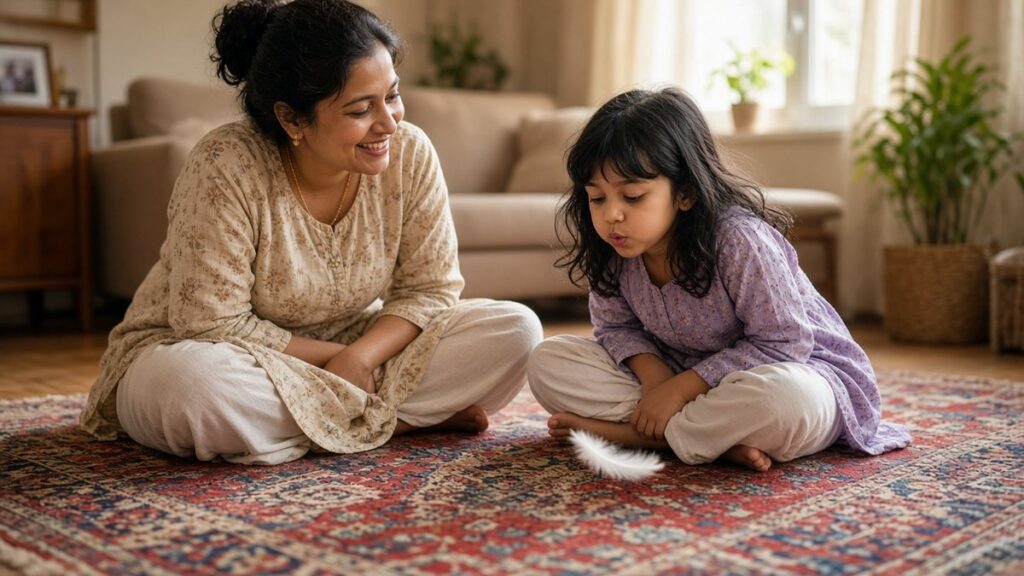
Children with asthma hear a lot about breathing. “Take your inhaler.” “Slow down.” “Are you wheezing?” It can start to feel like breathing is something that goes wrong. Breathing games flip that around. For a few minutes, breathing becomes something to play with, laugh about and feel good at.
These games are not medicine. They do not open tight airways, and they never replace a reliever or the plan your child’s doctor has given you. What they can do is help a child feel calmer, notice their body, and practise slow, relaxed breathing on good days, so that it feels familiar on harder ones.
This article is general education, not medical advice. Breathing games are complementary only and are not an asthma treatment. Always follow your child’s written asthma action plan. If your child is struggling to breathe, use their reliever as their plan says and call 112 immediately.
1. Why playful breathing helps children
Children learn through play much more easily than through instructions. A game gives them a reason to slow down and pay attention without feeling corrected. Over time, playful breathing practice can help children:
- notice the difference between calm breathing and fast, tense breathing
- feel a sense of control when they are upset or anxious
- settle down before sleep or after an exciting day
- talk more openly about how their chest feels
Anxiety and asthma can feed each other. A worried child may breathe faster, which can feel scary and make them more worried. Our post on the anxiety and asthma loop explains this cycle in more detail.
2. The golden safety rules
Before you start, keep these rules in mind:
- Play only on good days. Use breathing games when your child is well, in their green zone. Never use them as a response to wheeze, cough or breathlessness.
- Never instead of the reliever. If symptoms appear, follow the action plan first.
- No breath holding. Avoid games that ask children to hold their breath for long or blow as hard as possible.
- Stop if it feels uncomfortable. Dizziness, coughing or tiredness means it is time to stop and rest.
- Keep it short. Two to five minutes is plenty.
- Check with the doctor. If your child has severe asthma or you are unsure, ask their doctor whether gentle breathing practice is suitable.
3. Smell the flower, blow the candle
This classic works for children as young as three or four.
- Hold up a real flower, a picture of one, or simply pretend.
- Ask your child to breathe in gently through the nose as if smelling it.
- Then hold up a pretend birthday candle and ask them to breathe out slowly through the mouth, just enough to make the flame flicker, not blow it out.
- Repeat four or five times.
The idea is a soft breath in and a long, gentle breath out. Praise slowness, not strength.
4. Feather and cotton ball races
Place a feather, a cotton ball or a small scrap of paper on a smooth table or floor.
- Your child breathes out slowly to move it a little way across the surface.
- Make a “finish line” with a pencil.
- The challenge is to get it there with slow, gentle breaths, not one big blow.
You can turn it into a team game with siblings, where everyone takes turns moving the same cotton ball. Keep the mood light and stop before anyone gets tired.
5. Teddy bear belly breathing
This one is lovely before sleep.
- Your child lies on their back with a soft toy on their tummy.
- As they breathe in through the nose, the toy rises.
- As they breathe out through the mouth, the toy gently goes down.
- Ask them to “rock the teddy to sleep” with slow breaths.
Many children find this calming after a busy day or a long school function. It also helps them notice that the tummy can move with each breath, not just the shoulders.
6. Bumblebee hum
Ask your child to breathe in through the nose, then hum like a bee on a long, slow breath out. Older children can try to make the hum last a little longer each time, but never to the point of strain. The buzzing sound makes children giggle, and the long out breath naturally slows things down.
7. Star and hand tracing
- Hold up one hand with fingers spread.
- With the other index finger, trace up the side of the thumb while breathing in, and down the other side while breathing out.
- Continue across all five fingers.
Children can do this quietly in a classroom, on a bus or in a waiting room. You can also draw a star on paper and trace each point with a breath in and out.
8. Story breathing for little ones
Make up a short story where breaths are part of the action: a dragon who blows warm, gentle air to keep his friends cosy, a boat that needs a soft wind to reach the shore, a balloon that slowly fills and empties. Pause in the story for your child to take the dragon’s breath or blow the boat along. Story breathing works well for children who resist “exercises” but love pretend play.
9. Moving from breath games to asthma learning
Once your child is comfortable with breathing play, you can build on it with games that teach them about asthma itself: what triggers are, how inhalers work and when to ask for help. Explore free Asthma Friend Games for short, browser-based activities like the Trigger Match Memory Game and the Inhaler Technique Trainer. They are designed mainly for teens and adults, so younger children will enjoy them most with a parent reading and talking through each step.
Pair these games with real conversations. Our parent’s guide on how to explain asthma to your child has age-appropriate ideas, and 10 things kids with asthma want grown-ups to know is a gentle reminder to listen as much as you teach.
10. Where breathing games fit in the bigger picture
Breathing play sits alongside proper asthma care, not in place of it. The foundations are still:
- the medicines your child’s doctor has prescribed, used as directed
- good inhaler and spacer technique
- a written action plan that home and school both have
- reducing triggers such as smoke, dust and strong fragrances where you can
- regular check-ups so the plan stays up to date
If you are interested in breathing practice for older children or adults, our post on daily breathing exercises explains how to approach it carefully and with your doctor’s input.
Siddhant’s POV: Let breathing feel safe again
I have lived with asthma for more than 30 years, and my breathing improved after I moved from Delhi NCR to Dehradun. Because breathing has been such a big part of my life, I feel strongly that children should not grow up seeing it only as a source of fear.
My view is that a few minutes of playful breathing on a calm evening can change how a child feels about their own body. It will not replace a single puff of medicine, and it should never be used during a flare. But it can give children a sense of calm and confidence that stays with them, and that is worth a little time on the living room floor.
Siddhant Jain, founder of Asthma Friend, has lived with asthma for more than 30 years.
Conclusion
Breathing games give children with asthma a gentle, positive way to explore their breath. Keep them short, play them on good days, avoid breath holding and forceful blowing, and stop if anything feels uncomfortable. Above all, keep them in their place: a calm, fun extra that sits alongside your child’s medicines, action plan and doctor’s advice.
Take the next step with Asthma Friend
- Join our community: Connect with people who understand life with asthma at Asthma Friend.
- Learn through play: Explore free educational games at Asthma Friend Games.
- Create your free asthma action plan: Use the Asthma Friend Action Plan Generator and keep a copy where you and your family can find it.
Frequently asked questions
No. Breathing games are a calm, playful extra. They do not open airways or replace any medicine. Always follow your child’s doctor and written action plan.
No. During symptoms, follow the action plan and use the reliever as directed. If breathing is very difficult, call 112 immediately.
Simple games like smell the flower, blow the candle can work from around three or four years old. Older children can try hand tracing and belly breathing.
Two to five minutes is enough. Stop straight away if your child feels dizzy, starts coughing or seems tired.
Asthma Friend Games offers free browser-based games about triggers, myths and inhaler technique. They suit teens and adults, and younger children can play alongside a parent.
Free: Smog Season Survival Guide
A practical 27-page guide to breathing easier with asthma through India's pollution months: AQI explained, clean air at home, masks, kids and school, plus printable checklists. Join the free Asthma Friend newsletter and we'll email it to you.


Last reviewed: 14 November 2026
Information on this page was written against widely published guidance from national and international respiratory health bodies. It is educational only and is not a substitute for personal medical advice from a doctor.

About the author
Siddhant Jain
Siddhant Jain is the founder of Asthma Friend. He has lived with asthma for more than 30 years. After moving from Delhi NCR to Dehradun, his breathing improved, and he built Asthma Friend to give Indian patients and caregivers practical, empathetic education. The content is educational and is not a substitute for advice from a doctor.
Related posts:
 Effective Ways to Improve Respiratory Health and Prevent Respiratory Issues
 Asthma and Train Travel in India: A Preparation Checklist for Sleeper and AC Coaches
 How to Help Your Mom Breathe Easier: A Child’s Guide to Supporting an Asthmatic Mother
 Setting Boundaries with Smokers in the Family: Protecting Yourself from Asthma Triggers
 A Partner’s Checklist for Supporting Someone Through an Asthma Flare
 Nasal Irrigation for Asthma Relief: How It Helps & How to Do It Safely
 Journaling Prompts for Asthma Self-Awareness: A Simple Habit to Understand Your Triggers and Patterns
 How to Manage Asthma Naturally with Daily Breathing Exercises
 Asthma & Mountains: Does Clean Air Really Help?
 Sleeping Positions That Can Make Asthma Symptoms Better or Worse