
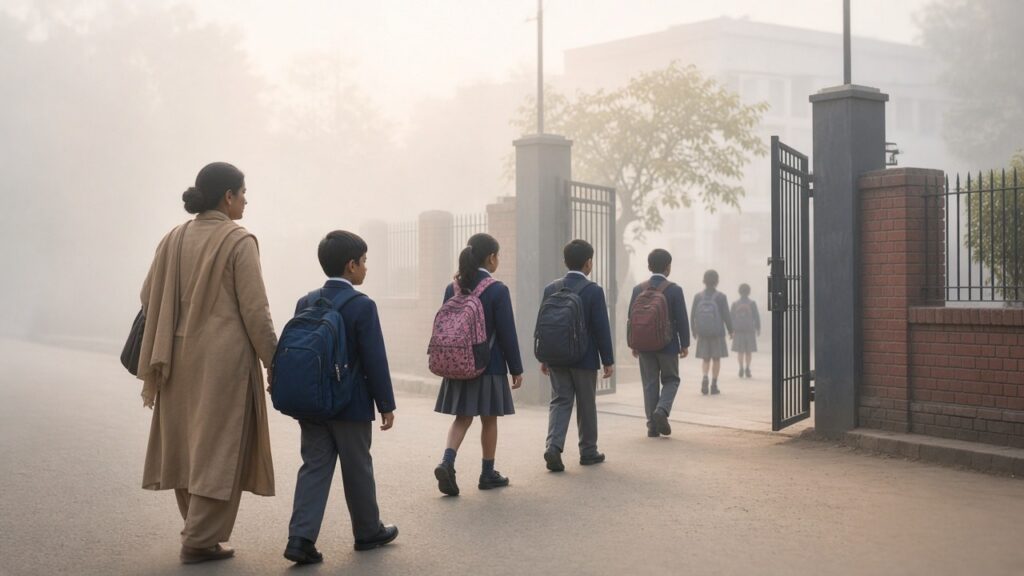
The festival lights come down, the sweets run out, and school starts again. For many families in North India, the week after Diwali also brings some of the haziest mornings of the year. Leftover firecracker smoke, stubble burning in nearby states, cooler air and low wind can all keep pollution sitting close to the ground. If your child has asthma, the question each morning becomes very practical: should they stand through outdoor assembly, play in the sports period, or take the usual bus or cycle route?
This guide is for parents and caregivers who want a calm, repeatable way to make those decisions. It does not replace your child’s doctor or their written asthma action plan. It gives you a way to think through the day, talk to the school, and notice when something needs medical attention.
This article is general education, not medical advice. Every child’s asthma is different. Please talk to your child’s doctor about symptoms and treatment, and never start, stop or change any asthma medicine based on a blog post. If your child is struggling to breathe, call 112 or go to the nearest emergency department.
Why the week after Diwali can be harder for children with asthma
Children breathe faster than adults and spend more time active and outdoors, so they take in more air relative to their size. On smoggy days that means more exposure to fine particles and irritant gases. Children with asthma can have airways that react more easily to that irritation, which may show up as cough, wheeze, a tight chest or getting tired faster than usual.
Several things tend to pile up at once after the festival:
- Firecracker residue that lingers for a few days when the wind is weak.
- Seasonal smoke from crop residue burning in parts of North India.
- Cooler mornings, which can trap pollution near the ground and add cold-air irritation.
- Disrupted routines during the holidays, such as late nights, travel and missed or delayed controller doses.
- Post-festival colds that spread in crowded homes and classrooms.
None of this means every child will have a flare. It means it is worth paying a little more attention for a week or two. For a broader picture of how the haze affects breathing, see our guide to the impact of air pollution on asthma.
A simple morning check before school
You do not need complicated tools. A short routine over chai or while packing the tiffin is enough.
Step 1: Check the air
Look at the AQI for your area on a trusted app or official source. Note the number and the colour band, and check whether it is expected to get better or worse through the morning. Our AQI guide for asthma in India explains what each band generally means for people with sensitive lungs.
Step 2: Check your child
Ask a few gentle questions, and watch rather than quiz:
- Did they cough at night or wake up breathless?
- Are they using their reliever more than their written plan says is usual?
- Do they look tired, pale or quieter than normal?
- Is there a new cold, runny nose or sore throat?
If the answers point to symptoms creeping up, follow the steps in your child’s written asthma action plan. If you do not have one yet, this is a good week to make one with their doctor.
Step 3: Check the day
Look at the timetable. Is there an outdoor assembly, a PE period, a sports practice or a field trip? How will your child travel? Knowing the day helps you decide what to ask the school for.
Outdoor assembly: what parents can reasonably ask for
Many schools hold morning assembly outdoors. On smoggy days that can mean fifteen to thirty minutes standing still in cold, polluted air at the worst time of day.
Things parents can reasonably ask for include:
- Permission for your child to stand at the back or near the building, with their reliever and spacer within reach.
- Permission to attend assembly indoors or in a corridor on high-AQI days, if the school allows it.
- A clear rule that your child can step away if they start coughing or feel tight, without being scolded.
- Awareness among class teachers that your child has asthma, where their inhaler is, and who to call.
Some schools move assembly indoors or shorten it on bad air days. If yours does not have a policy, a polite note can start the conversation. Our article on how Indian schools can become more asthma friendly for children has ideas you can share with the school management.
Sports, PE and practice sessions
Physical activity is good for children, including children with asthma. The aim is not to stop all movement for weeks. It is to think about where, when and how hard.
Questions to weigh
- How bad is the air right now? Hard running outdoors in very poor air is a different decision from a light game on a moderate day.
- How is your child today? A child who coughed all night may need a gentler day even if the AQI looks better.
- Is there an indoor option? Many schools can offer yoga, table tennis, stretching, indoor games or a library period.
- Is this a competition? Big events can push children to ignore symptoms because they do not want to let the team down.
Practical tips
- Ask the PE teacher whether your child can switch to indoor or lighter activity on high-AQI days without losing marks.
- Make sure your child knows they can stop and rest, and that they will not be called weak for it.
- Pack the reliever and spacer in an easy-to-reach pocket, not buried in the bottom of the bag.
- Agree on warm-up time. Some children do better with a gradual start.
- If your child has symptoms with exercise, talk to their doctor about what their plan should say for sports days.
Our guide to exercising in poor air quality with asthma goes deeper into how to adjust intensity, timing and route.
The commute: bus, auto, cycle or walk
The journey to school can be one of the most polluted parts of the day, especially near busy roads at peak hour.
Options to think about
- School bus or van: Ask whether windows can stay closed on bad days and whether the vehicle idles for long with the engine running near children.
- Auto or e-rickshaw: These are open to traffic fumes. A shorter route away from main roads may help, even if it takes a few minutes longer.
- Walking or cycling: Choose quieter lanes and parks where possible, and avoid standing near traffic signals or construction sites.
- Car: Keep windows up in heavy traffic and set the air to recirculate, as long as the cabin does not get stuffy.
About masks
Some families use a well-fitting mask for children on the commute. Mask fit matters, and not every child finds a mask comfortable, especially if they are already a bit breathless. Talk to your child’s doctor about whether a mask is suitable for them, and read our practical guide to choosing an N95 you can actually breathe in. Never force a mask on a child who says they cannot breathe in it.
Talking to the class teacher and school nurse
A short, friendly message helps more than a long complaint. You might include:
- Your child has asthma and may be more sensitive on high-pollution days.
- Where their reliever and spacer are kept, and that they are allowed to use it.
- What symptoms to watch for, such as repeated coughing, wheezing, trouble speaking in full sentences or lips looking blue or grey.
- Who to call, and that in an emergency the school should call 112.
- A copy of the written asthma action plan, if you have one.
Keep the tone collaborative. Teachers are juggling forty children and many concerns. A clear, simple note makes it easy for them to help.
Signs that mean you should seek medical help
Follow your child’s written plan, and get medical help quickly if you notice:
- Breathing that is fast, hard or noisy, or the ribs pulling in with each breath.
- Trouble speaking, eating or walking because of breathlessness.
- Lips, tongue or fingertips that look blue or grey.
- A reliever that is not helping, or is needed far more than the plan allows.
- Your child seeming very drowsy, confused or frightened.
In any of these situations, call 112 or go to the nearest emergency department. Do not wait to see if it settles.
Building a smog-season routine that lasts
The week after Diwali is often just the start of a long winter. A few habits make the season easier:
- Keep a simple diary of AQI, symptoms and reliever use for two weeks. It helps your child’s doctor see patterns.
- Keep a spare reliever and spacer at school if the school allows.
- Set up one cleaner-air room at home for sleep, with windows closed on bad nights.
- Review the action plan with your child’s doctor before the worst of winter.
- Praise your child for telling you about symptoms early.
Siddhant’s POV: Smoggy school mornings deserve thoughtful support
I have lived with asthma for more than 30 years. My breathing improved after I moved from Delhi NCR to Dehradun.
My view is that children should not have to choose between belonging at school and asking for breathing support. I would encourage parents to discuss outdoor assembly, sports and the commute with teachers before a smoggy morning becomes stressful. A clear agreement about indoor alternatives and access to the prescribed action plan is a kinder starting point than blame or embarrassment.
Siddhant Jain, founder of Asthma Friend, has lived with asthma for more than 30 years.
Conclusion
Post-Diwali smog does not have to mean either keeping your child at home for weeks or sending them out and hoping for the best. A short morning check of the air, your child and the timetable, plus a clear note to the school, gives you a middle path. Ask for indoor assembly or a place near the building, an easier PE option on bad days, and a shorter or quieter commute. Keep the action plan updated with your child’s doctor, and never hesitate to call 112 if breathing looks hard. With a little planning, school can carry on while your child’s lungs get the care they need.
Take the next step with Asthma Friend
- Join our community: Connect with people who understand life with asthma at Asthma Friend.
- Learn through play: Explore free educational games at Asthma Friend Games.
- Create your free asthma action plan: Use the Asthma Friend Action Plan Generator and keep a copy handy through the festive season.
Frequently asked questions
Not necessarily. Many children with asthma can attend school with small adjustments such as indoor assembly, lighter PE and a shorter commute. Decide based on your child’s symptoms, their written action plan and advice from their doctor.
Yes, you can politely ask. Many schools allow children with asthma to stand near the building or attend indoors on bad air days. A short note with your child’s needs and a copy of the action plan makes it easier for the school to agree.
It depends on how poor the air is and how your child is feeling that day. On very poor air days, indoor or lighter activity is often a gentler choice. Ask your child’s doctor what their plan should say about sports and exercise.
A well-fitting mask may reduce exposure for some children, but comfort and fit matter. Talk to your child’s doctor first, and never force a mask on a child who says they cannot breathe in it.
Hard or fast breathing, ribs pulling in, trouble speaking, blue or grey lips, a reliever that is not helping, or unusual drowsiness all need urgent care. Call 112 or go to the nearest emergency department.
It varies by city and weather every year. Wind, rain and temperature all play a part, so it is best to check the daily AQI rather than assume a fixed number of days.
Last reviewed: 8 November 2026
Information on this page was written against widely published guidance from national and international respiratory health bodies. It is educational only and is not a substitute for personal medical advice from a doctor.

About the author
Siddhant Jain
Siddhant Jain is the founder of Asthma Friend. He has lived with asthma for more than 30 years. After moving from Delhi NCR to Dehradun, his breathing improved, and he built Asthma Friend to give Indian patients and caregivers practical, empathetic education. The content is educational and is not a substitute for advice from a doctor.
Related posts:
 Controller vs Reliever Inhaler: What Each One Does in Asthma Care
 Winter Asthma in North India: A Practical Month-by-Month Guide
 Thank You, Mom: A Tribute to Mothers Who Help Their Children Breathe Easier
 Questions Parents Can Ask the School About a Child’s Asthma Plan
 How to Recognize Early Signs of an Asthma Attack
 Hotel Rooms and Asthma: Questions to Ask Before You Book
 Asthma and Staying with Relatives: How to Discuss Household Triggers
 Cold Air and Asthma: How to Plan Walks and Morning Commutes
 Diwali and Asthma: How to Celebrate Safer When Fireworks and Smoke Fill the Air
 Asthma and Train Travel in India: A Preparation Checklist for Sleeper and AC Coaches