
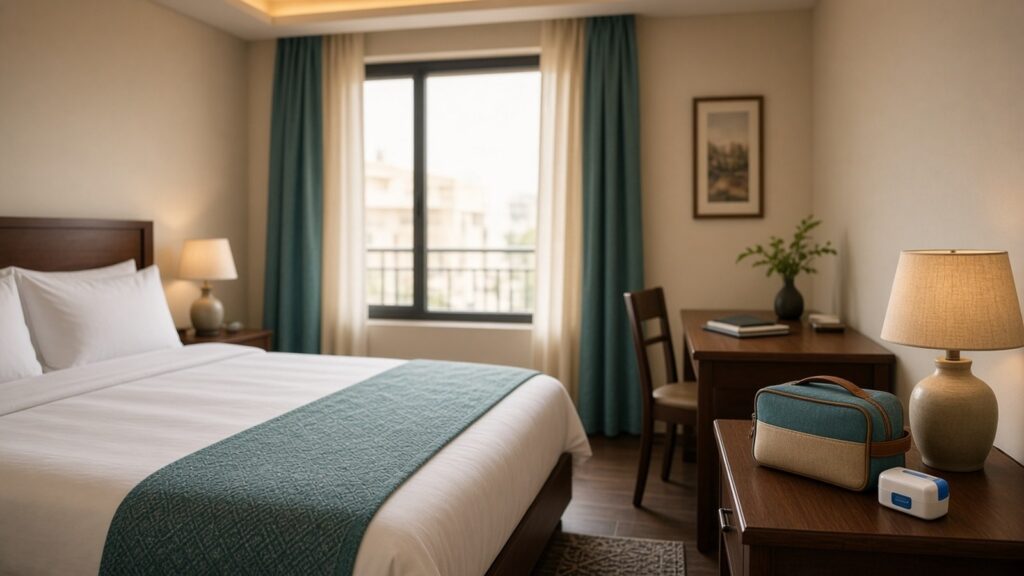
A hotel booking looks simple until you walk into the room and smell yesterday’s smoke, a cloud of room freshener, or dust rising from thick carpet. For anyone living with asthma, the room is not a backdrop. It is the air you will sleep in all night.
This is a booking and check-in checklist for Indian hotels and guest houses, built around hotel room asthma triggers. You will get questions to ask before you pay, a front-desk script for the first five minutes, what to do about AC, fragrance, renovation dust and adjoining rooms, and a quick reset routine once you have the keys. It is not a general travel packing list. It is about choosing and fixing the room itself.
This article is general education, not medical advice. Everyone’s asthma is different. Please talk to a doctor about individual symptoms and treatment, and never start, stop or change any asthma medicine based on a blog post.
1. Why hotel rooms can unsettle asthma overnight
Home is predictable. Hotel rooms turn over daily. Different guests, different cleaning products, different habits. Common irritants show up again and again:
- Smoke smell in “non-smoking” rooms. Curtains and soft furnishings hold odour long after a guest has checked out.
- Strong room freshener. Front desks sometimes spray heavily to cover other smells, which can be worse for sensitive airways.
- Dust from carpet, heavy drapes and unused sofas. Especially in older properties and festive-season rush rooms that were closed for weeks.
- AC filters that have not been cleaned recently. Cool air feels nice; dusty, musty airflow does not.
- Adjoining renovation or banquet kitchen exhaust. Hammering dust and frying fumes travel through corridors and window gaps.
If you are planning the wider trip, pair this room guide with our travel checklist for stress-free trips and, for flights, flying with asthma in India.
2. Questions to ask before you book
A two-minute call or chat message before payment saves a miserable midnight room change. Ask clearly, and note the answer in your booking confirmation email if you can.
- Do you have truly smoke-free floors, not only smoke-free rooms on mixed floors?
- Can you guarantee a room that has not been smoked in recently, and will you move me at check-in if it smells of smoke?
- Do you use strong room fresheners or incense in guest rooms? Can you prepare my room without fragrance?
- Is the room carpeted or hard flooring? (Hard floors are often easier if dust bothers you.)
- When were the AC filters in guest rooms last cleaned?
- Is any renovation, painting or banquet work happening near the rooms you would assign me?
- Can I request a higher floor away from the generator, kitchen exhaust or busy road?
- Is there a window that opens, and does the area outside tend to get kitchen smoke or generator fumes?
Frame it as preference, not drama: “I have asthma, so I need a fragrance-free, smoke-free room with a recently cleaned AC if possible.” Most decent properties would rather know before you arrive.
3. What to request in writing on the booking
Add a short note in the special requests box, then screenshot it:
- Smoke-free room on a smoke-free floor if available
- No room freshener, dhoop or scented candles in the room before arrival
- Quiet room away from renovation and banquet kitchen if possible
- Extra blankets instead of a dusty decorative runner if they usually pile those on
- Early check-in only if the room is fully cleaned and aired, not hastily sprayed
For fragrance specifically, our article on strong fragrances and perfumes explains why a closed hotel room and a heavy spray can be a bad combination.
4. The first five minutes at the front desk
Do not wait until you have dragged luggage to the top floor. Use a calm, specific script:
- “I had requested a smoke-free, fragrance-free room. Could you confirm that before I go up?”
- “If the room smells of smoke or strong freshener, I will need another room. Is that alright?”
- “Is there renovation on my floor tonight?”
- “Could housekeeping skip the room spray and just wipe surfaces, please?”
Smile, stay brief, and treat it like a food allergy request at a restaurant. You are giving them a chance to get it right.
5. Room inspection: a two-minute walk-through
Before you unpack, do this walk-through. If something fails, go downstairs again while the lobby still remembers your face.
- Smell test at the door. Smoke, mould, heavy perfume or pesticide should be a no.
- AC test. Turn it on. Musty or dusty airflow is a reason to ask for a filter clean or a different room. See also our guide to ideal AC settings for asthma comfort.
- Bathroom exhaust. Run it. Check for damp smell or blackish mould on grout.
- Windows and balcony. Note what is outside: generator, open kitchen, busy road, or a quiet courtyard.
- Soft surfaces. Give cushions a gentle pat. A dust cloud means ask for removals or a hard-floor room.
- Adjoining door. If there is a connecting door, make sure it seals. Ask who is next door if you smell paint or smoke.
6. Quick reset once you accept the room
Even a decent room benefits from a short reset, similar to how you might set up an asthma-friendlier bedroom at home. Our home guide on creating an asthma-friendly bedroom has ideas you can scale down for one night.
- Ask housekeeping to remove scented sticks, flower potpourri and spare pillows you will not use.
- Request fresh non-fragranced towels if the ones provided smell heavily of softener.
- Run the AC on fan or cool with a clean filter request, and keep the temperature comfortable rather than icy.
- Wipe the bedside table and remote with a damp cloth you carry, rather than dry-dusting.
- Keep your reliever on the bedside, not buried in a suitcase.
- If you use a small travel purifier, place it near the bed on a stable surface, not blocked by curtains.
7. Special cases: guest houses, wedding hotels and road-trip stops
Small guest houses
Charming, and sometimes smokier. Ask whether anyone smokes in the lobby or on shared balconies. Courtyard rooms can be lovely if incense is not lit under your window every evening.
Wedding and banquet hotels
Corridors fill with perfume, marigold waste and late-night kitchen smoke. Request a room as far from the banquet hall as possible, and confirm there is no overnight setup work outside your door.
Road-trip hotels
Highway properties may sit beside diesel generators and truck bays. Ask for a courtyard-facing room. For the driving day itself, our road trip with asthma guide covers the journey between stops.
8. If the room is wrong: escalate without a scene
- Return to the desk promptly. Explain the specific trigger: smoke smell, freshener, mould, renovation dust.
- Ask for another room on a different floor, not a quick spray of even more fragrance.
- If nothing suitable exists, ask for a cancellation or move to a partner property. Keep screenshots of your written requests.
- Do not sleep “through” severe irritation to be polite. One bad night can spoil the whole trip.
Call 112 or go to the nearest emergency department if breathing becomes severe, you cannot speak in full sentences, lips look blue or grey, or your reliever is not helping. A hotel stay is never worth delaying urgent care.
9. Packing add-ons that make hotel air easier
- Reliever and controller inhalers in your hand luggage, with spare doses for delays
- A small pack of unscented wet wipes and a microfibre cloth
- A mask you tolerate, for dusty corridors or strong lobby perfume
- Your written asthma action plan photo on your phone
- Optional: compact travel purifier if you already own and use one at home
- A light shawl so you are not dependent on a musty extra quilt
10. After check-out: notes for the next booking
When a stay goes well or badly, jot three lines in your phone before you forget:
- Property name and the exact room type or floor that worked
- What the smell and AC were like on arrival
- Whether the desk honoured fragrance-free and smoke-free requests without a fight
Those notes make the next booking faster than starting from zero, especially if you travel the same route every year for weddings or festivals.
11. Talking to travel companions about room needs
Partners, parents and friends sometimes treat room requests as optional. Align before you reach the lobby:
- Agree that smoke smell or heavy freshener is a valid reason to change rooms, not a quirk to laugh off.
- Decide who will speak to the desk so you are not arguing in front of staff.
- Share the packing list so someone else can fetch the reliever from the bag if you are unwell.
- If you are sharing a room, ask companions to skip strong perfume and late-night incense “for ambience”.
Clear teamwork turns a medical need into a simple trip rule, the same way you would plan vegetarian meals for someone who needs them.
A final reminder on medicines while travelling
Keep controllers and relievers in hand luggage through every journey to the hotel, including trains and cabs. Temperature extremes in a car boot can be harsh on devices, and late-night chemist hunts in unfamiliar neighbourhoods are stressful. If your asthma has been unstable before a trip, talk to your doctor in advance rather than improvising doses in a hotel room.
Siddhant’s POV: Keys first, unpack later
I have lived with asthma for more than 30 years, and hotel check-ins taught me a simple rule: smell the room before you unpack. Looking polite while hanging clothes in a smoky cupboard only made nights harder.
My breathing improved after I moved from Delhi NCR to Dehradun, but travel still means other people’s rooms. Asking for a fragrance-free, smoke-free space is not fussiness. It is how I keep a trip enjoyable instead of spending it at the window gasping for cleaner air.
Siddhant Jain, founder of Asthma Friend, has lived with asthma for more than 30 years.
Conclusion
Hotel room asthma triggers are often fixable if you ask early and inspect before you settle. Choose smoke-free and fragrance-free on purpose, check the AC and adjoining works, reset soft surfaces, and escalate quickly when the room is wrong. Talk to your doctor about travel plans if your asthma has been unstable. A calm front-desk script and a two-minute walk-through can protect your sleep more than any fancy suite upgrade.
Take the next step with Asthma Friend
- Join our community: Connect with people who understand life with asthma at Asthma Friend.
- Learn through play: Explore free educational games at Asthma Friend Games.
- Create your free asthma action plan: Use the Asthma Friend Action Plan Generator and keep a copy handy.
Frequently asked questions
Ask about smoke-free floors, fragrance-free preparation, AC filter cleaning, nearby renovation, and a room away from kitchens or generators. Get the answers before you pay when you can.
Not always. Odour can linger in curtains and carpets, and some floors mix smoking and non-smoking rooms. Inspect on arrival and request a change if it smells of smoke.
Strong sprays and scented amenities bother many people with sensitive airways, especially in closed rooms. Request no freshener and ask housekeeping to skip perfume sprays.
Ask the desk for a filter clean or another room. Sleeping with musty airflow overnight is a common reason people wake tight-chested. Do not ignore it to avoid inconvenience.
A compact unit can help some travellers who already use one, but it is optional. Room choice and fragrance-free preparation usually matter more for a short stay.
If breathing is severe, speaking is hard, lips look blue or grey, or your reliever is not helping, call 112 or go to the nearest emergency department straight away.
Last reviewed: 8 November 2026
Information on this page was written against widely published guidance from national and international respiratory health bodies. It is educational only and is not a substitute for personal medical advice from a doctor.

About the author
Siddhant Jain
Siddhant Jain is the founder of Asthma Friend. He has lived with asthma for more than 30 years. After moving from Delhi NCR to Dehradun, his breathing improved, and he built Asthma Friend to give Indian patients and caregivers practical, empathetic education. The content is educational and is not a substitute for advice from a doctor.
Related posts:
 Controller vs Reliever Inhaler: What Each One Does in Asthma Care
 Why Asthma Symptoms Can Come Back After You Think You’re Better
 Allergic Rhinitis at Night: Nasal Care Routines to Ease Nocturnal Asthma
 Diwali Gifting for Someone with Asthma: Thoughtful, Trigger-Free Ideas
 Air Purifiers for Asthma in Indian Homes: HEPA, CADR, Room Size and a Winter Smog Setup
 Asthma and Staying with Relatives: How to Discuss Household Triggers
 Questions Parents Can Ask the School About a Child’s Asthma Plan
 Diwali and Asthma: How to Celebrate Safer When Fireworks and Smoke Fill the Air
 Room Heaters and Asthma in India: Oil-Filled vs Fan vs Halogen, Angithi Smoke and Safe Winter Warmth
 Flying with Asthma from India: Inhalers in Hand Baggage, Airport Security and Dry Cabin Air