
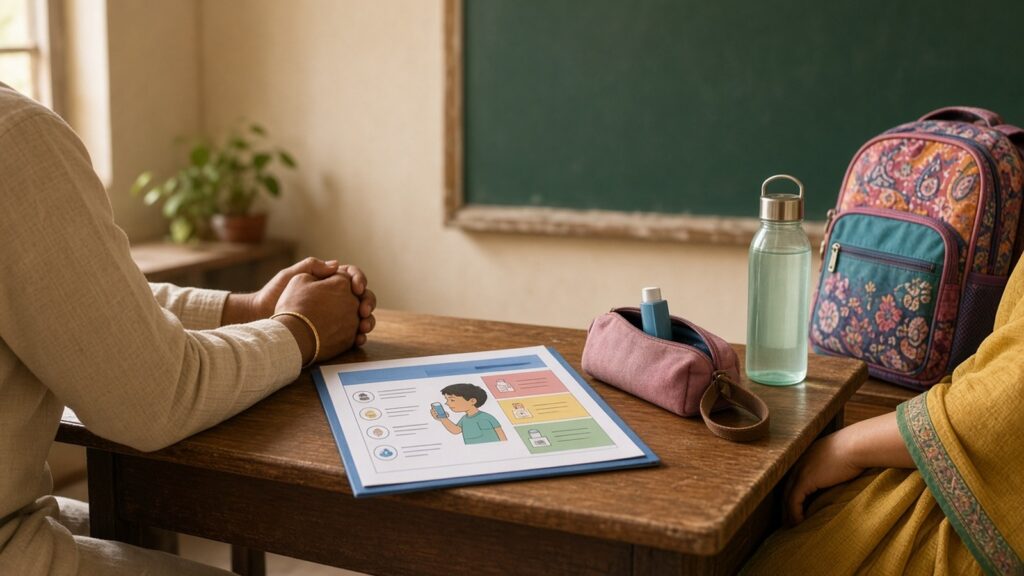
Most Indian schools care about children. What they often lack is a clear, shared script for asthma. Parents pack an inhaler, write a note in the almanac, and hope the class teacher will “know what to do”. Then a dusty PE period, a cold classroom or a sudden wheeze arrives, and everyone is improvising.
This article is a practical list of school asthma action plan questions parents can ask the class teacher, coordinator or office. It is for Indian schools of many kinds: CBSE, state board, private, government-aided and play schools. You will leave with a meeting checklist, not a lecture. Nothing here tells you to change medicines. That stays with your child’s doctor.
This article is general education, not medical advice. Every child’s asthma is different. Please talk to a doctor about individual symptoms and treatment, and never start, stop or change any asthma medicine based on a blog post.
1. Why a short school meeting beats a long WhatsApp note
A written note helps, but a ten-minute conversation creates shared memory. Teachers change sections. Sports coaches rotate. Substitutes arrive on exam weeks. If only one person “sort of knows”, the plan fails on the day you need it.
A calm meeting also reduces stigma. When you frame asthma as a common, manageable condition with a clear plan, staff are less likely to treat it as either a mystery or a drama. For a broader school culture view, see how Indian schools can become more asthma-friendly for children.
Aim to meet before the new term, before winter pollution peaks, or right after a diagnosis or plan change. Bring a one-page summary signed or approved by your clinician whenever possible.
2. What to bring to the meeting
- A one-page asthma action plan written in simple English (and a local-language copy if that helps the school)
- Your child’s inhaler and spacer labelled with name and class, if the doctor has advised a spacer
- Emergency contact numbers in priority order: parents, another relative, doctor clinic number
- A short list of usual triggers that matter at school (dust, cold air, viral coughs going around, strong cleaners, pollen, exercise)
- A photo of the devices so substitutes recognise them
- Any school forms the office already requires for medicines on campus
If you are still building the medical plan itself, our guide on how to develop an asthma action plan can help you prepare questions for the doctor first. The school meeting comes after clinical clarity, not instead of it.
3. Questions about where the inhaler is kept
Access beats perfect paperwork. Ask:
- Where will the reliever inhaler be stored during class hours?
- Can my child carry it in a waist pouch or bag if the doctor and school policy allow self-carry?
- Who holds the key if medicines sit in a locked cupboard?
- What happens during exams, library periods, activity classes and outdoor PE when the child is not at their desk?
- How will a substitute teacher find the inhaler in the first five minutes of need?
- Is there a second labelled spare on campus, and who checks expiry dates each term?
Many parents also pack a school-ready kit in the bag. Our checklist on preparing an asthma-friendly school bag covers practical packing without turning the bag into a pharmacy.
4. Questions about who can supervise medicine use
Indian schools vary widely: some have a nurse, many do not. Clarify roles without assuming a clinic on every floor.
- Who is allowed to supervise or assist with the inhaler during school hours?
- Has that person seen a quick demo of my child’s device and spacer technique?
- What is the plan if the usual teacher is on leave?
- How do you handle a child who feels embarrassed to use an inhaler in front of classmates?
- Will staff ever give a medicine that is not on the written plan?
- How do you document that a dose was supervised, so parents are informed the same day?
Be explicit: staff should follow the written plan and call parents or emergency services when thresholds are reached. They should not invent new doses because a well-meaning auntie in the staff room suggested it.
5. Questions for PE, sports day and dusty drills
Physical education, marching practice, annual day rehearsals and dusty playgrounds are common trigger moments. Ask:
- How do PE teachers know my child has asthma before a running drill starts?
- Can my child warm up gently and pause without being labelled lazy?
- Where is the inhaler during outdoor games: with the child, with the coach, or back in class?
- What is the plan for very dusty grounds, freshly cut grass, or cold early-morning assemblies?
- On high pollution days in our city, can outdoor PE be shortened or moved indoors?
- Who decides if my child sits out a race when early warning signs appear?
Early warning signs matter as much as emergency signs. Share a short list with staff using language from our guide on how to recognise early signs of an asthma attack, adapted to what your doctor confirmed for your child.
6. Questions about classrooms, cleaning and common triggers
School buildings have their own air stories: chalk dust, strong floor cleaners, incense on festival days, damp storage rooms, and sealed AC classrooms in some cities.
- Are strong-smelling cleaners used while children are in the room?
- Can windows be adjusted on high-pollution days versus muggy days?
- Is chalk dust heavy in this classroom, and are there lower-dust board options?
- Will festival celebrations involving incense or smoke happen inside the classroom?
- Where does my child sit if they are sensitive to the AC vent or to open windows facing traffic?
- How are classmates asked not to share perfume samples, deodorant sprays or mosquito coils near my child?
You are not asking the school to rebuild the campus. You are asking for small, realistic adjustments and a named person who will remember them.
7. Questions about emergencies and calling for help
This is the section that prevents tragic delays. Ask clearly:
- What exact symptoms mean you call parents immediately?
- What exact symptoms mean you call 112 or take my child to the nearest emergency department without waiting for a parent callback?
- Who carries the emergency contact card on a field trip or bus?
- How will I be informed if the reliever was needed during school?
- Is there a first-aid trained staff member on campus during school hours?
- What is the route to the nearest hospital the school already uses?
Tell staff: if the child has severe breathlessness, cannot speak in full sentences, has blue or grey lips, or is not improving as the written plan expects, call 112 or go to emergency care straight away. A parent stuck in traffic is not a reason to wait.
For home and travel kits that mirror school readiness, see creating an asthma emergency kit for your home.
8. A sample script you can adapt
You do not need perfect English. You need calm clarity. Try:
- “My child has asthma. Here is a one-page plan from our doctor with green, yellow and red steps written simply.”
- “This pouch has the reliever and spacer. Please keep it where a substitute can find it in one minute.”
- “If you hear persistent cough, wheeze or the child says the chest feels tight, please follow the yellow steps and call me.”
- “If breathing looks severe or the plan’s emergency box applies, please call 112. Do not wait for me to answer the phone.”
- “We will update you if the doctor changes anything. Please tell us if reliever use at school becomes more frequent.”
Offer to demonstrate device use once. Teachers remember a two-minute demo better than a long PDF.
9. After the meeting: keep the plan alive
A meeting dies if nobody revisits it. Build light follow-up into the year:
- Send a short termly reminder on the parent WhatsApp or almanac: “Asthma plan unchanged; inhaler in pouch X.”
- Update the school the same week if the doctor changes devices or steps.
- Ask for a two-line note whenever the reliever was needed at school.
- Repack the school bag after holidays so devices are not left at home.
- Before sports day or a long picnic, reconfirm who is carrying the inhaler.
- If your child is newly diagnosed, share a short age-appropriate explanation so classmates are kind, not curious in a hurtful way. Our childhood asthma overview can help you find words: understanding childhood asthma.
10. What not to expect from the school
Schools are partners, not clinicians. Keep expectations fair:
- Do not expect staff to diagnose a new illness or change doses.
- Do not expect every teacher to remember a ten-page medical essay.
- Do not assume a locked office cupboard equals quick access.
- Do not skip doctor reviews because “school has the inhaler”.
- Do not shame your child for needing help. Confidence is part of the plan.
11. Field trips, buses and half-day events
Many plans fail outside the classroom. Ask specifically about movement days.
- Who carries the inhaler on the school bus or van?
- Is there a labelled kit with the class teacher on picnics and museum trips?
- What is the meeting point if the child feels tight during a crowded outing?
- How will staff reach you if network coverage is poor at the venue?
- Are smoke, strong food stalls or dusty grounds expected at the destination?
- Who makes the call to leave early if symptoms escalate away from campus?
If your child stays for after-school tuition in the same building, repeat the access questions for that later slot. The morning teacher may have gone home.
12. Building your child’s confidence without burdening them
A good school plan protects dignity as well as airways. Children do better when they know a simple script and are not forced to become the only expert in the room.
- Teach a short sentence: “I need my inhaler and a quiet minute.”
- Practise spacer or inhaler steps at home until they feel ordinary.
- Agree with teachers that classmates will not be asked to “watch the medical thing” as entertainment.
- Praise the child for speaking up early, not only for “pushing through”.
- Keep adult responsibility with adults. A child can participate; they should not carry the whole emergency plan alone.
Confidence grows when school and home use the same words. If the doctor’s plan says “yellow zone”, try not to invent a different colour system only for school unless everyone understands the translation.
Siddhant’s POV: The questions that prevent panic
I have lived with asthma for more than 30 years. As a child, the scariest moments were not always the symptoms themselves. They were the pauses when adults around me were unsure what to do next.
My breathing improved after I moved from Delhi NCR to Dehradun, and that change reminded me how much environment and preparation matter together. For parents, a short school asthma action plan conversation is one of the kindest forms of preparation. It turns “someone might help” into “we already agreed what happens”.
Siddhant Jain, founder of Asthma Friend, has lived with asthma for more than 30 years.
Conclusion
A school asthma action plan works when devices are findable, roles are named, PE and dust days are discussed, and emergency thresholds are unmistakable. Take a one-page plan, ask the questions in this guide, leave a clear contact list, and follow up each term. Keep medical decisions with your child’s doctor. If severe breathing trouble starts at school, staff should call 112 or go to the nearest emergency department without delay.
Take the next step with Asthma Friend
- Join our community: Connect with people who understand life with asthma at Asthma Friend.
- Learn through play: Explore free educational games at Asthma Friend Games.
- Create your free asthma action plan: Use the Asthma Friend Action Plan Generator and keep a copy handy.
Frequently asked questions
Keep it to one page when possible: usual medicines and devices, early warning signs, step-by-step actions for worsening symptoms, emergency contacts, and clear instructions to call 112 for severe breathing trouble. Final medical details must come from your child’s doctor.
Ask the doctor and the school. Many children benefit from quick access through a labelled pouch or bag if policy allows. The key is that a responsible adult can find and supervise the device within moments.
Start with the class teacher and also inform the coordinator or office. If a nurse or counsellor exists, include them. Make sure substitute teachers can find the written plan.
Follow the written emergency steps and call 112 or go to the nearest emergency department for severe breathlessness, difficulty speaking, blue or grey lips, or symptoms that are not improving as the plan expects. Do not wait only for a parent callback.
Update whenever the doctor changes the plan, and send a short reminder each term. Also refresh the conversation before sports day, camps or pollution season if those are hard months for your child.
Ask where the inhaler will be during games, how early symptoms are handled without blame, and what happens on dusty or high-pollution days. Agree that sitting out briefly is allowed when warning signs appear.
Last reviewed: 1 November 2026
Information on this page was written against widely published guidance from national and international respiratory health bodies. It is educational only and is not a substitute for personal medical advice from a doctor.

About the author
Siddhant Jain
Siddhant Jain is the founder of Asthma Friend. He has lived with asthma for more than 30 years. After moving from Delhi NCR to Dehradun, his breathing improved, and he built Asthma Friend to give Indian patients and caregivers practical, empathetic education. The content is educational and is not a substitute for advice from a doctor.
Related posts:
 Controller vs Reliever Inhaler: What Each One Does in Asthma Care
 How to Recognize Early Signs of an Asthma Attack
 Why Asthma Symptoms Can Come Back After You Think You’re Better
 GRAP Stages Explained for Asthma Families in Delhi NCR: What Each Stage Means for Your Day
 Thank You, Mom: A Tribute to Mothers Who Help Their Children Breathe Easier
 Allergic Rhinitis at Night: Nasal Care Routines to Ease Nocturnal Asthma
 Flying with Asthma from India: Inhalers in Hand Baggage, Airport Security and Dry Cabin Air
 How to Avoid Asthma Triggers: A Comprehensive Guide
 Winter Asthma in North India: A Practical Month-by-Month Guide
 What to Keep in Your Work Bag If You Have Asthma: A Practical Checklist