
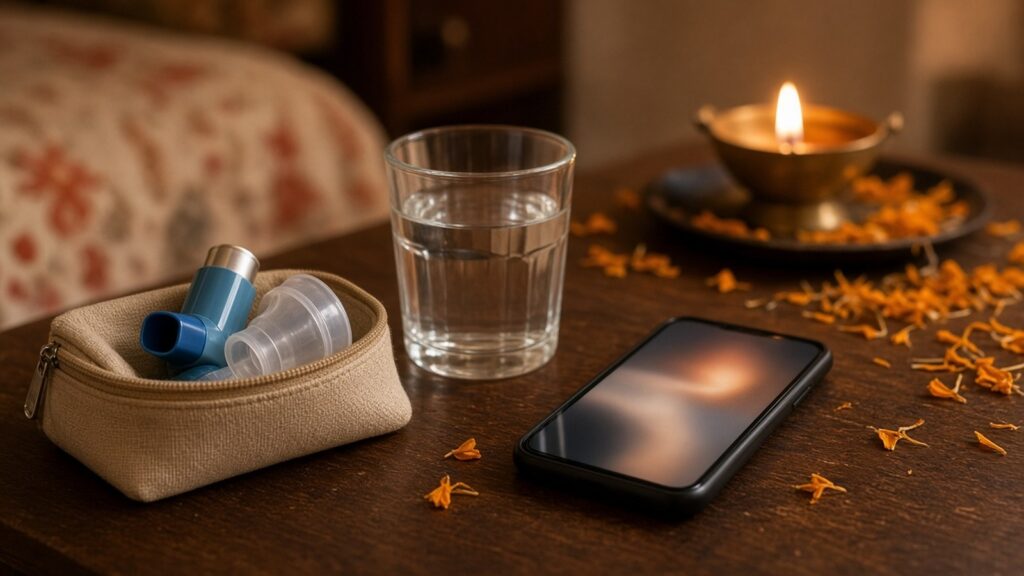
Diwali week rearranges everything: late aartis, travel between homes, irregular meals, guests on the sofa and fireworks past midnight. For many people with asthma, the medicines stay the same while the clock does not. That is when controller doses get skipped “just for tonight,” spacers get left in another city, and morning doses slide into afternoon chaos.
This guide is about keeping your asthma routine during festivals steady through Diwali week: reminders, packing, pairing doses with habits that still happen, and recovering after a missed dose without improvising new medical rules. It is schedule support, not a dose-change plan.
This article is general education, not medical advice. Everyone’s asthma is different. Please talk to a doctor about individual symptoms and treatment, and never start, stop or change any asthma medicine based on a blog post. If you miss doses or your symptoms change, contact your clinician for personal advice.
1. Why Diwali week disrupts inhaler routines
Asthma routines usually hang on anchors: brush teeth, breakfast, bedtime. Festive weeks remove those anchors.
- Late nights push bedtime doses into the next calendar morning
- Travel between family homes separates you from the drawer where the inhaler usually lives
- Guests and noise make quiet bathroom routines harder
- Smoke and cleaning dust can increase symptoms while adherence slips
- Children’s sleep schedules shift, so supervised doses shift too
A solid everyday foundation still helps. If you are rebuilding basics after the festival, see how to build an asthma-friendly daily routine. This piece focuses on surviving the disrupted week itself.
2. Protect the controller habit without changing the dose
Controller (preventer) inhalers only help when they are taken as prescribed. Festival week is not the moment to invent a new schedule on your own. Instead, protect the existing one with better cues.
- Phone alarms with festival-proof labels: “Controller now” beats a vague chime you will dismiss
- Pair with something that still happens: after brushing teeth, after the first chai, before putting on festive clothes
- Use a visible pouch: keep the controller and spacer together on the dressing table, not buried under gift wrap
- Ask one family member to cue you during multi-day travel, the way someone reminds elders about other medicines
- Do not double up to “catch up” unless your doctor has specifically told you how to handle missed doses
For why regular medicine matters as prevention, read taking medication as part of asthma prevention. Bring questions about missed doses to your doctor rather than guessing.
3. Reliever readiness when evenings run late
Reliever inhalers are for quick relief as your doctor has directed. During Diwali, the risk is simply not having it with you when smoke or dust peaks.
- Carry the reliever in a small bag that moves with you from kitchen to terrace to car
- Check the dose counter or feel of the canister before a long evening out
- Tell one trusted person where it is during crowded gatherings
- Do not leave it in a coat pile near the fireworks zone
Technique still matters when you are tired. A quick refresh of common inhaler technique errors can prevent wasted puffs during a noisy night.
4. Packing for multi-home Diwali travel
Many families sleep in two or three places across the week. Pack as if each night is a mini trip.
- Controller, reliever and spacer in hand luggage, not the boot of the car under suitcases
- A written note of your usual times, for grandparents or hosts helping a child
- Spare spacer mouthpiece wipes or a clean cloth as your clinician has suggested for hygiene
- A small torch or phone light for late-night doses in unfamiliar bathrooms
- Emergency contact numbers and your action plan printout or phone copy
Device care on the road matters too. See how to maintain inhalers and spacers so festive dust does not end up inside your kit.
5. Late nights, early mornings and “I’ll take it later”
The most common festive failure mode is delay. You mean to take the dose after guests leave. Guests leave at 1 a.m. You fall asleep. Morning arrives in another house.
Practical tactics
- Take the scheduled dose at the next sensible anchored moment the same day, then return to the usual clock as your doctor has advised for timing questions
- Set two alarms 20 minutes apart on heavy nights
- If you are the caregiver, link the child’s dose to a non-negotiable act such as washing face before sleep, even if sleep is late
- Avoid stacking “extra” puffs to compensate unless a clinician has told you exactly what to do
When smoke is also part of the night, pair adherence with exposure sense. Our safer Diwali fireworks and smoke guide helps you plan the evening around air, not only around the clock.
6. Meals, fasting windows and medicine timing questions
Some households adjust meal times around puja, travel or guests. Inhaled asthma medicines are not the same as tablets that must sit with food, but confusion still happens.
- Do not invent new rules about taking inhalers only on an empty or full stomach unless your doctor has given that instruction for a specific medicine
- If you also take tablets for asthma or allergies, ask your clinician before the festival how festive meal shifts should work
- Keep water nearby; rushing dry-mouthed through a dose when guests are calling you is a recipe for poor technique
Again: timing puzzles belong to a conversation with your doctor, not a blog checklist.
7. Children, teens and shared supervision
During Diwali, caregivers change. Aunts, grandparents and older siblings may supervise doses.
- Show the exact technique once, slowly, before the busy evening starts
- Write times on a sticky note on the spacer bag
- Agree who carries the reliever when the child goes to the terrace with cousins
- Praise routine sticking the same way you praise festive help in the kitchen
Keep an asthma emergency kit idea in mind even when you are not at your own home: a pouch with what the child’s doctor has recommended, plus phone numbers.
8. After a missed dose: calm next steps
Missing a dose feels worrying. Panic improvisation feels worse.
- Follow whatever missed-dose instructions your doctor or pharmacist has already given you
- If you have no personal instruction, contact your clinician or pharmacist for advice rather than doubling on your own
- Watch for rising symptoms over the next day and follow your written action plan
- Repair the system: better alarm, better pouch location, clearer family cue for the next night
If breathing becomes severe, you cannot speak full sentences, lips look blue or grey, or the reliever is not helping as directed, call 112 or go to the nearest emergency department.
9. A Diwali-week adherence checklist
- Controller and reliever packed before the first overnight trip
- Alarms labelled and tested
- One family cue person identified
- Spacer cleaned and stored as usual
- Action plan accessible on phone
- Reliever bag moves with you during fireworks evenings
- No DIY dose changes
- 112 known to hosts helping children
10. When symptoms rise despite good adherence
Sometimes you take every dose and still feel worse because smoke, dust or a virus is stacking up. That is not failure of character. It is a reason to use your action plan and call your doctor sooner.
- Note what exposures happened: cleaning, fireworks, crowded markets
- Keep a simple symptom log for 24 to 48 hours
- Do not borrow someone else’s inhaler or change devices without clinical advice
- Seek urgent help for severe symptoms rather than waiting until after the festival
11. Work calls and festive dose clashes
If you are working through Diwali week, video calls can collide with dose times. Treat the controller alarm like a hard meeting.
- Block five minutes on your calendar around dose times
- Keep the inhaler at the desk you actually use that week, not in a festive bedroom suitcase
- Use a short stretch break after a dose so technique is not rushed between mute buttons
- If smoke from nearby celebrations enters through windows during calls, close them and pause outdoor balcony meetings
Professional weeks and festival weeks often overlap in India. Your prescribed routine deserves a calendar block the same way a client call does.
12. A sample day map (illustrative, not a prescription)
Here is a pattern many families find workable. Your doctor’s timing instructions always win if they differ.
- Morning: dose paired with brushing teeth before the first outing
- Daytime travel: reliever pouch in the bag that leaves the house
- Evening guests: second labelled alarm before dinner chaos peaks
- Late fireworks: reliever with you on the terrace; return indoors if smoke is heavy
- Bedtime: night medicines only as prescribed, even if bedtime is late, then sleep
Maps fail without a pouch and an alarm. Put those two tools in place first. A little structure beats a week of apology doses.
13. Hosts and guests: share the routine load
If relatives are staying with you, or you are staying with them, say the routine out loud once on arrival day. Silence is how inhalers get left in the wrong bathroom.
- Point to the pouch location in the first ten minutes
- Agree who reminds whom without nagging tone
- Put a sticky note on the guest-room mirror with morning and night cues if a child is visiting
- Ask hosts not to “tidy away” medical pouches into unknown drawers
Shared houses run on shared information. A one-minute tour beats a midnight search.
14. After Diwali: reset without guilt
When the week ends, rebuild the ordinary anchors instead of scolding yourself for imperfect nights.
- Return inhalers to their weekday home spot the morning after the last overnight
- Review technique once when you are less tired
- Book or attend any doctor review you already planned if symptoms were bumpier than usual
- Keep the labelled alarm for one more week while sleep schedules normalise
Festivals end. Routines can return without shame. That reset is part of care.
Siddhant’s POV: Anchors beat willpower
I have lived with asthma for more than 30 years, and festive weeks used to expose how fragile a “I will remember” plan can be. Willpower fades when the house is full and the night is long. Anchors and alarms work better.
My breathing improved after I moved from Delhi NCR to Dehradun, yet I still treat Diwali week as a routine risk, not only a pollution risk. Cleaner air helps. Showing up for the doses I already have with my doctor helps more than any last-minute improvisation.
Siddhant Jain, founder of Asthma Friend, has lived with asthma for more than 30 years.
Conclusion
Diwali week does not have to undo your asthma routine. Expect late nights and travel, then defend your prescribed schedule with alarms, visible pouches, family cues and packed kits. Do not change doses on your own. If you miss one, get personal advice and repair the system for the next night. When breathing turns urgent, call 112. A steady routine is one of the quietest gifts you can give yourself during a loud festival.
Take the next step with Asthma Friend
- Join our community: Connect with people who understand life with asthma at Asthma Friend.
- Learn through play: Explore free educational games at Asthma Friend Games.
- Create your free asthma action plan: Use the Asthma Friend Action Plan Generator and keep a copy handy through the festive season.
Frequently asked questions
Use labelled phone alarms, pair doses with habits that still happen, keep inhalers in a visible travel pouch, and ask one family member to cue you. Do not invent new doses. Ask your doctor about any timing confusion.
Follow the missed-dose advice your doctor or pharmacist has already given. If you do not have personal instructions, contact them rather than doubling up on your own. Then fix alarms and pouch placement for the next dose.
No blog should tell you to change doses. Talk to your doctor if symptoms rise or if you are unsure how to use your action plan during high-smoke evenings.
In a small bag that stays with you, not in a coat pile or another room. Tell one trusted person where it is in crowded gatherings.
Show technique once in daylight, write times on the spacer bag, agree who carries the reliever, and share emergency numbers including 112.
Call 112 or go to emergency care for severe breathlessness, difficulty speaking, blue or grey lips, or a reliever that is not helping as directed.
Last reviewed: 1 November 2026
Information on this page was written against widely published guidance from national and international respiratory health bodies. It is educational only and is not a substitute for personal medical advice from a doctor.

About the author
Siddhant Jain
Siddhant Jain is the founder of Asthma Friend. He has lived with asthma for more than 30 years. After moving from Delhi NCR to Dehradun, his breathing improved, and he built Asthma Friend to give Indian patients and caregivers practical, empathetic education. The content is educational and is not a substitute for advice from a doctor.