
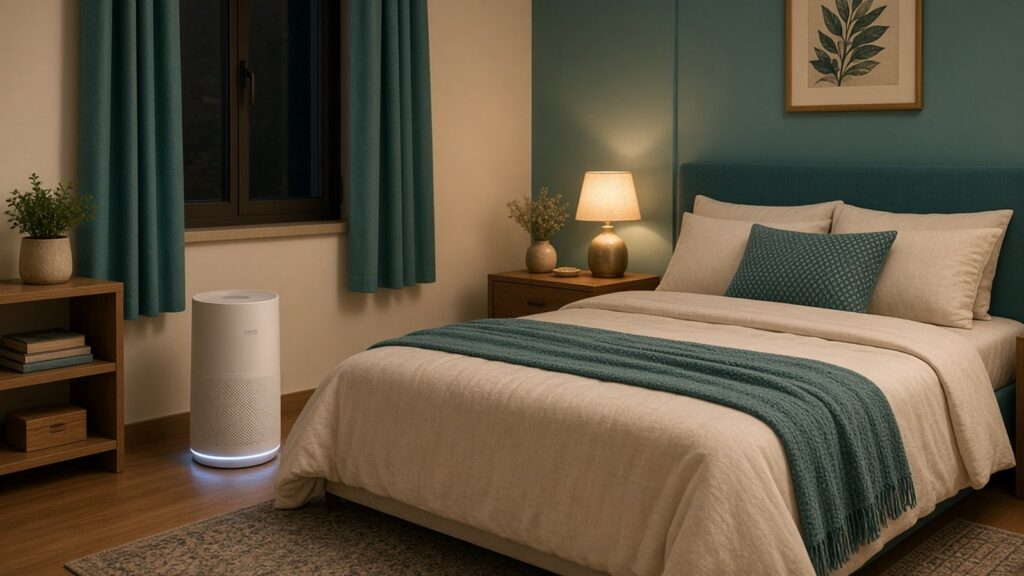
When the AQI app turns red, the family WhatsApp group fills with air-purifier links. Some people swear by them. Others call them expensive fans. If you live with asthma in an Indian flat, you are left with practical questions: which features matter, how big should it be for your room, what to avoid, and how to run it through winter smog without wasting money on the wrong box.
This is a buyer and setup guide for an air purifier for asthma India homes. We will cover true HEPA, CADR matched to room size, ozone-producing extras to skip, filter running costs, and a cleaner-air room plan for smog weeks. It is about sizing and winter operation, not indoor plants or a full bedroom makeover.
This article is general education, not medical advice. Everyone’s asthma is different. Please talk to a doctor about individual symptoms and treatment, and never start, stop or change any asthma medicine based on a blog post.
1. What an air purifier can and cannot do for asthma
A good room purifier can lower particulate levels in a closed space when it is sized correctly and the filters are fresh. That may mean less irritation from outdoor smog that has leaked indoors, and less dust circulating while you sleep. It is a tool, not a cure, and it does not replace your medicines or your doctor.
It will not fix:
- Smoke you keep creating indoors with incense, dhoop or mosquito coils
- A constantly open window onto a highway during peak smog
- Mould growing behind a damp wall
- Strong fragrances from cleaning products
- Unstable asthma that needs a clinical review
Think of it as one part of a cleaner-air routine, alongside wet mopping, kitchen exhaust use and smarter window timing. For the wider home picture, see asthma-friendly home tips and our guide to living with asthma in Delhi NCR.
2. True HEPA: the filter words that actually matter
Marketing pages love adjectives. For particulate pollution, the useful phrase is true HEPA or HEPA-grade filtration that captures fine particles with high efficiency. Be cautious with vague labels like “HEPA-type” or “HEPA-like” without clear performance detail.
- True HEPA / H13-style claims: Often what people shopping for asthma-related dust and smog particle reduction look for. Read the product sheet, not only the Amazon title.
- Pre-filter: Catches larger dust and hair so the HEPA lasts longer. Wash or vacuum it as the manual says.
- Activated carbon: Helps with some odours and certain gases. Useful in Indian kitchens and traffic-facing flats, but carbon saturates and needs timely replacement.
- UV, ionisers and “ozone fresh” modes: Extra features are not automatically better. Avoid anything that intentionally produces ozone in a bedroom. Ozone can irritate airways.
If a salesperson pushes a strong “perfume” or ion spray mode as the main benefit, walk away. You want particle filtration, not a new scent machine.
3. CADR and room size: match the machine to the room
CADR means Clean Air Delivery Rate. In plain language, it is how quickly the unit can deliver cleaned air. A small desktop unit in a large living room will run forever and still leave you disappointed.
Practical matching tips for Indian homes:
- Measure the room you care about most, usually the bedroom. Note length × width, and roughly how high the ceiling is.
- Check the manufacturer’s recommended room size and CADR for dust or smoke. Prefer a unit rated for your room or slightly larger, especially in high-smog cities.
- One strong bedroom unit often helps more than one weak unit shared across an open hall.
- If your living room and kitchen are open-plan, you may need a higher CADR unit, plus a kitchen chimney that actually gets used. See kitchen chimneys and exhaust fans for indoor PM2.5.
- Do not hide the purifier behind curtains or under a table. Side clearance matters for airflow.
A common winter mistake is buying for the showroom living room, then sleeping in an untreated bedroom. Put your best filtration where you spend eight hours with the door closed.
4. Filter cost, noise and power: the real running bill
The sticker price is only the entry fee. Before you buy, ask:
- How often do HEPA and carbon filters need replacement in heavy smog use?
- What do genuine replacement filters cost in India, and are they easy to find?
- Is there a filter-life indicator you can understand?
- How loud is the unit on the speed you will actually use at night?
- Does it have a sleep mode that is still effective enough for your room size?
A silent unit that is too small, or a powerful unit you switch off because it whines, both fail. Test noise in the shop if you can, or buy from a seller with a clear return window.
5. Features worth having vs features to skip
Often worth it
- Clear filter replacement alerts
- A decent sleep or low-noise mode
- Child lock if you have toddlers who love buttons
- Simple controls you will use without an app
- A pre-filter you can clean at home
Usually skip or treat with caution
- Ozone-generating modes
- Heavy fragrance or “aroma” trays marketed as wellness
- Complicated app ecosystems you do not need
- Giant LED light shows in a bedroom
- Unverified medical cure claims on the box
6. Winter smog setup: a cleaner-air room that works
On high AQI weeks, create one primary cleaner-air room, usually the bedroom:
- Close windows during the worst outdoor hours. Ventilate briefly when outdoor air is relatively better, if your local pattern allows.
- Run the purifier with the door closed for a head start before bedtime.
- Keep incense, dhoop and smoking out of this room entirely.
- Avoid vigorous dry dusting; prefer damp cloths.
- Place the unit a little away from walls, not stuffed in a corner.
- If you also use a room heater, watch dryness and dust. Our guide to room heaters for asthma covers safer heater habits.
For bedroom layout beyond the machine, see asthma-friendly bedroom tips. For reading the outdoor numbers that drive your window decisions, use AQI and asthma in India.
7. Where to place it in typical Indian flats
- Bedroom: Beside the bed with clear airflow, not directly blowing icy air onto your face all night if that bothers you.
- Child’s room: Stable position, cable tucked away, child lock on.
- Living room: Central-ish spot if this is your daytime zone, away from the cooking plume.
- Avoid: Right next to an open window sucking raw outdoor smog, or inside a closed cupboard “for looks”.
8. Buying checklist you can screenshot
- True HEPA (or clearly specified high-efficiency particle filter), not vague “HEPA-type” only
- CADR / room size match for your bedroom or main room
- No ozone mode you might accidentally enable
- Known filter prices and availability in India
- Acceptable night noise on a real setting
- Return or exchange window after you test it at home
- Plan for one primary cleaner-air room in smog season
If your symptoms are increasing this winter despite cleaner indoor habits, talk to your doctor. A purifier is support gear, not a diagnosis tool and not a reason to change inhaler doses on your own.
Call 112 or go to the nearest emergency department for severe breathlessness, difficulty speaking, blue or grey lips, or a reliever that is not helping.
9. Maintenance habits that keep the machine honest
A neglected purifier becomes furniture. Build tiny habits:
- Vacuum or wash the pre-filter on the schedule in the manual, more often in dusty months.
- Order replacement HEPA and carbon filters before the indicator screams empty, especially before peak smog.
- Wipe the exterior vents so dust does not cake around the intake.
- After a renovation or heavy festive cleaning day at home, expect filters to load faster.
- If the unit smells odd or airflow drops suddenly, pause and check filters rather than spraying room freshener on top.
Write the last filter-change date on a tape label on the side of the machine. Future you will thank present you during a November rush.
10. When a purifier is not the next step
Sometimes the better spend is elsewhere first:
- Fixing a kitchen chimney that never gets switched on
- Stopping indoor smoking and incense in the sleeping room
- Seeing your doctor because night symptoms are escalating
- Improving a damp wall that keeps feeding mould
Gadgets work best after the obvious indoor smoke sources are handled. If money is tight, prioritise medical review and smoke-free sleeping air over a premium unit you cannot maintain.
And remember: outdoor AQI still matters when you step out. A perfect bedroom does not make a long scooter ride through smog risk-free. Combine indoor tools with commute choices and your written action plan.
11. Sharing the cost and the remote in a joint family
In many Indian homes the purifier becomes a contested remote. Agree basics early:
- Bedroom door closed at night when someone with asthma is sleeping there.
- No using the unit as a night light party feature for children.
- A shared calendar note for filter changes so one person is not stuck with every expense.
- Permission to turn off fragrance or ion modes if someone enabled them “helping”.
If relatives gift you a unit that is clearly undersized, thank them, use it in a smaller study if useful, and still save for a properly sized bedroom machine when you can. Gratitude and correct sizing can coexist.
Siddhant’s POV: One room done well
I have lived with asthma for more than 30 years, and winter gadgets always tempted me with big promises. What helped more than collecting devices was making one sleeping room genuinely kinder to my chest.
My breathing improved after I moved from Delhi NCR to Dehradun, where outdoor air is often gentler. Even then, I care about filter basics over fancy modes. If you are still in a high-smog city, size the purifier to the room you sleep in, keep filters fresh, and do not expect a small unit to clean an entire open hall.
Siddhant Jain, founder of Asthma Friend, has lived with asthma for more than 30 years.
Conclusion
An air purifier for asthma in Indian homes works best when you match true HEPA filtration and CADR to a real room size, skip ozone gimmicks, budget for filters, and run a closed cleaner-air bedroom through smog weeks. Pair the machine with less indoor smoke, sensible window timing and your usual medical plan. Talk to your doctor about ongoing symptoms. Cleaner indoor air is a daily habit, not a single shopping link.
Take the next step with Asthma Friend
- Join our community: Connect with people who understand life with asthma at Asthma Friend.
- Learn through play: Explore free educational games at Asthma Friend Games.
- Create your free asthma action plan: Use the Asthma Friend Action Plan Generator and keep a copy handy.
Frequently asked questions
Prioritise true HEPA particle filtration sized to your room, plus honest filter replacement costs. Skip ozone-producing modes and heavy fragrance add-ons.
Measure the room and choose a unit rated for that size or slightly larger, especially for bedrooms in high-smog cities. A small desk unit will not clean a large hall.
Many people run one in a closed bedroom overnight on a tolerable quiet setting. Follow your unit’s manual, keep filters fresh, and place it with clear airflow.
Not necessarily. One well-sized unit in the bedroom often helps more than several undersized units. Add another only if you spend long hours in a second closed space.
No. It may reduce some particle exposure indoors, but it does not replace prescribed treatment. Never start, stop or change medicines based on buying a device. Talk to your doctor.
Avoid vague HEPA-type labels without detail, ozone modes, aroma trays marketed as therapy, and units with no clear filter supply in India.
Call 112 or go to emergency care for severe breathlessness, trouble speaking, blue or grey lips, or a reliever that is not helping.
Last reviewed: 8 November 2026
Information on this page was written against widely published guidance from national and international respiratory health bodies. It is educational only and is not a substitute for personal medical advice from a doctor.

About the author
Siddhant Jain
Siddhant Jain is the founder of Asthma Friend. He has lived with asthma for more than 30 years. After moving from Delhi NCR to Dehradun, his breathing improved, and he built Asthma Friend to give Indian patients and caregivers practical, empathetic education. The content is educational and is not a substitute for advice from a doctor.
Related posts:
 Monsoon Laundry: Indoor Drying Without Triggering Asthma
 Asthma and Staying with Relatives: How to Discuss Household Triggers
 Is Your Child Wheezing With Every Cold? Viral Wheeze vs Asthma in Children Under 5
 Smog or Fog? Why Hazy Winter Mornings Are Not All the Same for Asthma
 Silent Asthma vs. Anxiety: How to Tell the Difference
 Spacer 101: Use, Cleaning, and Common Mistakes
 How to Create an Asthma Friendly Bedroom for Better Sleep
 Silent Asthma: The Hidden Danger of Asthma Without Wheezing
 Setting Boundaries with Smokers in the Family: Protecting Yourself from Asthma Triggers
 New Year Resolutions to Manage Your Asthma Better in 2026