
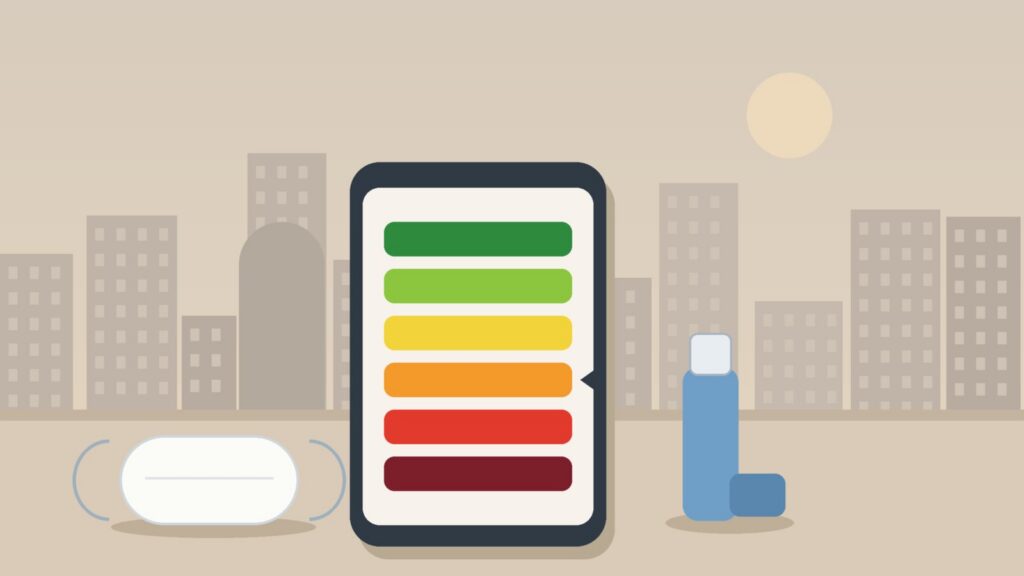
Every year, somewhere between late October and December, the sky over much of North India turns a dull grey that refuses to lift. Phones buzz with air quality alerts, news channels flash big red numbers, and family WhatsApp groups fill with screenshots. If you live with asthma, those numbers are not just headlines. They can shape how your chest feels by evening. This guide explains asthma AQI India basics in plain words: what the colours mean, why stubble season makes things harder, and how to use the daily reading to plan your day.
It is written for adults with asthma and for parents of children with asthma, especially in Delhi NCR, Punjab, Haryana, western Uttar Pradesh and other parts of the Indo-Gangetic plains, though the ideas work in any Indian city with a pollution season.
This article is general education, not medical advice. Everyone’s asthma and triggers are different. Please talk to your doctor about your own symptoms and treatment, and never start, stop or change any asthma medicine on your own.
1. What the AQI number actually measures
The Air Quality Index, or AQI, is a single number that sums up how polluted the outdoor air is at a monitoring station. India’s National Air Quality Index looks at up to eight pollutants, including fine particles (PM2.5), coarser particles (PM10), nitrogen dioxide, sulphur dioxide, ozone and carbon monoxide.
Each pollutant gets its own score, and the overall AQI you see is the worst of those scores. During the smoky months, that worst pollutant is very often PM2.5. These are particles so small that they can travel deep into the airways, which is why people with asthma often notice them first.
A few things are worth knowing before you trust any number:
- It is usually an average. Particle readings in the official index are based on averages over many hours, so the air at 7 AM can be much worse or better than the headline figure.
- It is local. A station near a busy road and one near a park in the same city can show very different readings.
- It is outdoor air. Your home, office or car may be better or worse depending on ventilation, cooking, incense and smoking.
- Scales differ. Some apps and devices use other countries’ AQI scales, which have different cut-offs. The same number can mean different things, so check which scale your app uses and stick to one.
2. Asthma AQI India colours: what each band can mean for you
India’s index has six bands, each with its own colour. Here is a practical way to read them if you have asthma. These are general planning ideas, not rules. Your doctor and your own written plan come first.
Good (0 to 50): dark green
Air is generally clean. A good day for outdoor walks, exercise and opening windows to air out the house.
Satisfactory (51 to 100): light green
Most people are fine. A few very sensitive people may notice mild discomfort. Carry on as normal, with your reliever in your pocket as always.
Moderate (101 to 200): yellow
This is the band where people with asthma, other lung conditions and heart disease may start to feel breathing discomfort. Keep plans, but notice how you feel. Shorten hard outdoor exercise if your chest feels tight.
Poor (201 to 300): orange
Breathing discomfort becomes likely for many people with longer exposure. With asthma, this is a good day to move workouts indoors, keep outdoor time short and purposeful, and keep windows closed during the worst hours.
Very Poor (301 to 400): red
Longer exposure can cause breathing problems even in healthy people. Limit time outdoors to what is truly needed, wear a well-fitting mask if you must go out, and watch your symptoms closely.
Severe (401 to 500): maroon
The air can affect healthy people and seriously affect people with existing conditions. Stay indoors as much as you reasonably can, avoid all outdoor exercise, and follow your asthma action plan closely if symptoms start.
A simple rule many families find useful: the higher the band, the shorter, slower and more planned your outdoor time should be.
3. Why stubble season makes October to December harder
Several things pile up at the same time in North India during these months:
- Crop residue burning. After the paddy harvest, stubble is burnt in many fields, and the smoke can drift across large areas.
- Calmer winds and cooler nights. Cold air near the ground can trap pollution under a lid of warmer air, so smoke and dust do not disperse easily, especially in the early morning and late evening.
- Festival smoke. Firecrackers around Diwali and weddings add sudden spikes.
- Everyday sources. Traffic, construction dust, burning of garbage and leaves, and smoke from wood or coal fires for warmth all continue.
- Fog mixing with smoke. On some winter days, fog and pollution combine into thick smog.
This is why AQI in the same city can swing from Moderate to Severe within a few days. If you want a wider view of the whole season, our month-by-month guide to winter asthma in North India walks through what to prepare for from October to March, and our article on living with asthma in Delhi NCR covers the bigger picture of life in the region.
4. The number vs how you feel: use both
AQI is a useful warning light, but your body is the real dashboard. Some people with asthma feel fine at an orange reading, while others feel tight in the yellow band. Both are normal, because asthma is personal.
Over a couple of weeks, try noting the morning AQI next to how your chest felt that day. You may notice a pattern, for example that your cough starts once readings stay in the Poor band for two or three days. That pattern is gold for your next doctor visit.
Watch for early signs that the air is getting to you:
- Coughing more, especially at night or early morning
- A tight or heavy chest
- Wheezing or a whistling sound when you breathe out
- Needing your reliever inhaler more often than usual
- Feeling breathless with things you normally manage easily, like stairs
If these signs keep showing up, they may mean your asthma is not as settled as it should be. Our guide on signs your asthma is not well controlled explains what to look out for and what to do next.
5. How to plan your day by AQI colour
Here is a simple daily routine that takes two minutes and can save you a bad evening.
Step 1: Check the reading before you step out
Look at the AQI for the station nearest your home and, if different, near your office or your child’s school. Check the hourly trend too, not just one number. Is it rising or falling?
Step 2: Match your plans to the band
- Green bands: normal day. Good time for outdoor exercise and airing out the house.
- Yellow: normal day with attention. Keep your reliever with you and slow down if your chest complains.
- Orange: shift workouts indoors, choose less busy routes, and keep outdoor time short.
- Red or maroon: outdoor time only for what is needed, a well-fitting mask, windows closed, and a calm, indoor day where possible.
Step 3: Pick the better hours
In winter, early mornings and late evenings are often the worst times because pollution gets trapped close to the ground. If you have a choice, the early afternoon is frequently better, but check the hourly trend for your area rather than assuming.
Step 4: Think about exercise carefully
Exercise is good for asthma, and you do not have to give it up in winter. On orange, red and maroon days, consider swapping a park run for indoor options like yoga, stretching, stair-free home workouts or a gym with closed windows. If exercise itself tends to trigger your symptoms, our guide to exercise-induced asthma explains how to work with your doctor on it.
Step 5: For parents and the school run
- Check whether your child’s school has a plan for outdoor play and assembly on poor air days.
- Make sure the school has a copy of your child’s asthma action plan and their reliever and spacer.
- On bad days, walk the quieter lanes, not the main road, if you walk to school.
- Ask your child, in simple words, to tell a teacher if their chest feels tight or they cannot stop coughing.
6. Short outdoor errands on a high-pollution day
Life does not stop because the AQI is red. You still need milk, medicines, a bank visit or a quick trip to the sabzi market. A few habits can make these short trips easier:
- Bundle errands into one trip instead of several small ones.
- Go at the better hour of the day for your area, if you can.
- Walk slowly. Heavy breathing pulls more polluted air deeper into your lungs.
- Avoid standing next to traffic signals, bus stops on busy roads, burning garbage and construction sites.
- Wear a well-fitting mask, not a loose cloth one.
- Keep your reliever inhaler in your pocket, not at home.
- In a car, keep windows up and use recirculation mode in heavy traffic.
- Once home, wash your face and hands, and change out of dusty outerwear if it helps you feel better.
7. Making home a cleaner-air base
On bad air days, home is where you spend most of your hours, so small changes there count.
- Keep doors and windows closed during the worst hours, then air out briefly when readings dip.
- Avoid adding indoor smoke: no incense sticks, dhoop, mosquito coils or smoking indoors.
- Use a kitchen chimney or exhaust fan while cooking, especially when frying or tempering.
- Damp dust and mop instead of sweeping dry dust into the air.
- If you use an air purifier, choose one sized for your room and run it with windows closed.
- Avoid wood, coal or angithi fires indoors for warmth.
8. Masks on smoggy days
A well-fitting N95 or similar respirator-style mask can reduce how much fine particle pollution you breathe in outdoors. Surgical and cloth masks do much less against fine particles. The fit matters as much as the mask: gaps around the nose and cheeks let unfiltered air in.
Some people with asthma find tight masks uncomfortable, especially when walking fast. Our practical guide to choosing an N95 mask you can actually breathe in covers sizing, valves and comfort. If a mask makes you feel more breathless, slow down, step aside to rest and talk to your doctor about it.
9. When to seek medical help
Do not wait for the AQI to improve if your asthma is clearly getting worse.
Book a doctor review if
- You are using your reliever more than usual for several days.
- You are waking at night with cough or wheeze.
- Your symptoms are worse every pollution season and you want a plan for it.
- You do not have a written asthma action plan, or it is out of date.
If you do not have a plan yet, our step-by-step guide on how to develop an asthma action plan is a good place to start.
Call 112 or go to the nearest emergency department straight away if
- Breathing is very hard or you are struggling to breathe
- You cannot speak in full sentences
- Your lips or fingertips look blue or grey
- Your reliever is not helping, or you need it again very soon
- You feel drowsy, confused or exhausted from the effort of breathing
Siddhant’s POV: The air around you matters more than you think
I have lived with asthma for more than 30 years, and much of that time was in Delhi NCR. When I moved to Dehradun, my breathing improved. That experience taught me how closely the air we breathe is tied to how asthma feels day to day.
Not everyone can move, and nobody should feel they have to. But everyone can learn to read the AQI, notice their own early signs and plan around the worst hours. Checking a number each morning sounds small. Over a long pollution season, those small decisions add up.
Siddhant Jain, founder of Asthma Friend, has lived with asthma for more than 30 years.
Conclusion
Understanding asthma AQI India readings turns a scary headline into a useful daily tool. Know the six colour bands, remember that the number is an outdoor average for one location, and pay attention to how your own chest responds. On orange, red and maroon days, keep outdoor time short and slow, move exercise indoors, wear a well-fitting mask and keep your home a cleaner-air base. Keep your reliever with you, follow your action plan, see your doctor if symptoms keep creeping up, and call 112 in an emergency. Stubble season is hard, but a plan means fewer bad days.
Take the next step with Asthma Friend
- Join our community: Connect with people who understand life with asthma at Asthma Friend.
- Learn through play: Explore free educational games at Asthma Friend Games.
- Create your free asthma action plan: Use the Asthma Friend Action Plan Generator and add what you will do on poor air days.
Frequently asked questions
There is no single cut-off for everyone. Many people with asthma start to notice symptoms in the Moderate (101 to 200) band, and the Poor, Very Poor and Severe bands carry more risk. Track how your own chest responds and agree a plan with your doctor.
Smoke from crop residue burning, calm winds, cooler nights that trap pollution near the ground, festival firecrackers, traffic, construction dust and fires for warmth all add up during these months.
Not always. Some apps use other countries’ scales, which have different cut-offs, so the same number can mean different things. Check which scale your app uses and stick to one so you can compare days fairly.
Not necessarily. Exercise is still good for asthma. On Poor, Very Poor or Severe days, consider moving workouts indoors and choosing the better hours of the day. If exercise triggers your symptoms, talk to your doctor.
A well-fitting N95 or similar mask can reduce how much fine particle pollution you breathe outdoors. Fit is key. If a mask makes you feel more breathless, slow down and discuss it with your doctor.
In many North Indian cities, early mornings and late evenings are often worse because cold air traps pollution near the ground. Check the hourly trend for your own area before planning outdoor time.
Call 112 or go to the nearest emergency department if breathing is very hard, you cannot speak in full sentences, your lips look blue or grey, or your reliever is not helping.
Last reviewed: 1 November 2026
Information on this page was written against widely published guidance from national and international respiratory health bodies. It is educational only and is not a substitute for personal medical advice from a doctor.

About the author
Siddhant Jain
Siddhant Jain is the founder of Asthma Friend. He has lived with asthma for more than 30 years. After moving from Delhi NCR to Dehradun, his breathing improved, and he built Asthma Friend to give Indian patients and caregivers practical, empathetic education. The content is educational and is not a substitute for advice from a doctor.
Related posts:
 How Intermittent Fasting Affects Asthma: Benefits, Risks, and Considerations
 The Impact of Strong Fragrances and Perfumes on Asthma
 Winter Asthma in North India: A Practical Month-by-Month Guide
 How to Avoid Asthma Triggers: A Comprehensive Guide
 Asthma on Long Road Trips: Stops, Dhaba Smoke, Highway Fog and Medicine Planning
 Is Your Child Wheezing With Every Cold? Viral Wheeze vs Asthma in Children Under 5
 Karva Chauth Fasting with Asthma: Planning Water, Medicines and the Long Wait for Moonrise
 Lifestyle Changes to Improve Sleep Apnea and Asthma Together
 Cold vs Asthma Flare: How to Tell and What to Do
 Independence Day Special: 78 Years Strong, Let’s Build Better Asthma Awareness & Respiratory Care in India