
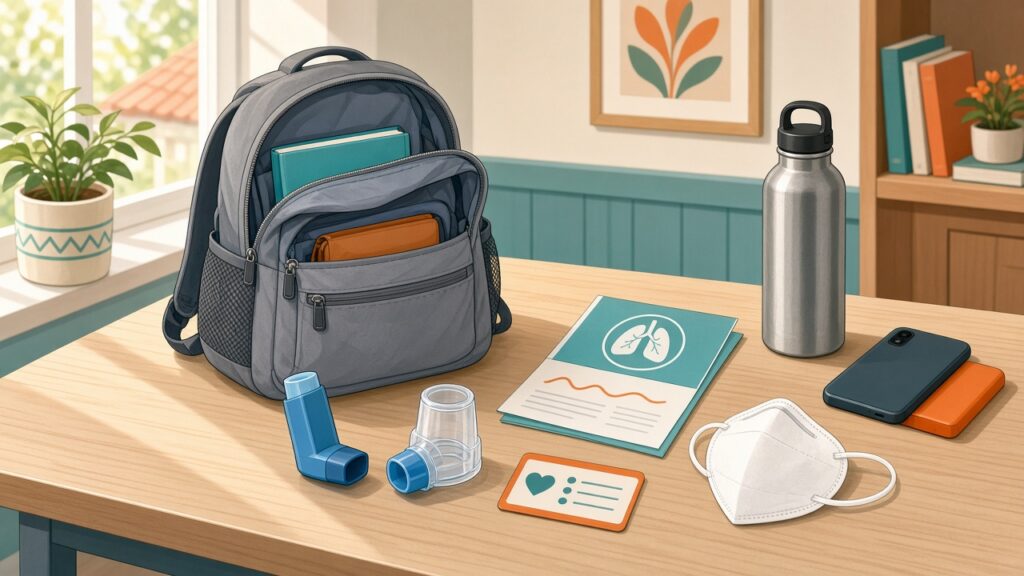
Most of us pack our work bag on autopilot. Laptop, charger, wallet, keys, maybe a tiffin. But if you live with asthma, there is one question worth asking every morning: if my chest tightened at 4 PM in a meeting room, or halfway home in a crowded metro, would I have what I need?
For a lot of people in India, the honest answer is no. The reliever inhaler is sitting on the bedside table, or it is in yesterday’s bag, or it is in the bag but almost empty. This guide walks you through what to keep in your work bag if you have asthma, why each item matters, and how to build a simple routine so the bag is always ready.
This article is general education, not personal medical advice. What you need to carry depends on your own asthma and the treatment your doctor has prescribed. Use this as a starting checklist and discuss it with your doctor.
1. Why your work bag matters more than you think
Asthma does not keep office hours. Symptoms can start during the commute, in an air-conditioned conference room, near the office smoking area or after a colleague sprays a strong perfume. Many working adults spend nine to twelve hours a day away from home once you add travel, so the bag you carry is effectively your mobile asthma kit.
We have already written about building an asthma emergency kit for your home. A work bag is different. It has to be small, light, travel-proof and ready for situations where you may be among strangers or colleagues who do not know you have asthma.
- You may be far from home or a pharmacy for most of the day.
- Long commutes in traffic, autos, buses or the metro can expose you to smoke, dust and crowding.
- Office triggers such as fragrances, cleaning products and air-conditioning vary from day to day.
- If you have a flare-up, the people around you need quick, clear information to help.
2. The non-negotiables: what should always be in the bag
If your bag only has room for a few things, these are the items most people with asthma will want with them every working day. Your doctor can tell you which of them apply to you.
Your reliever inhaler
This is the most important item. Your reliever, often a blue inhaler, is what your action plan usually tells you to use when symptoms start. If your doctor has prescribed a combination inhaler that you use for both prevention and relief, then that is the inhaler you carry.
- Check the dose counter, or check how many doses are left, at least once a week.
- Keep it in the same pocket of the bag every day so you can find it by touch.
- Carry the one that is prescribed to you. Never borrow or share someone else’s inhaler.
A spacer, if you use one
Many people find a spacer helps more medicine reach the lungs, especially during a flare-up when breathing is fast and coordination is harder. Compact and collapsible spacers are easier to carry. Our guide to using and cleaning a spacer covers how to keep it in good shape.
A copy of your asthma action plan
A written asthma action plan tells you, and anyone helping you, what to do when symptoms get worse. Keep a printed copy folded in the bag and a photo of it on your phone. If you do not have one yet, you can create a draft with the free Asthma Friend Action Plan Generator linked at the end of this article and review it with your doctor.
An emergency contact and medical information card
A small card with a few key details can save precious minutes if you cannot speak easily. Include:
- Your name and the words “I have asthma”.
- The names of the medicines you use, exactly as written on your prescription.
- Any known allergies, especially to medicines.
- One or two emergency contacts with phone numbers.
- Your doctor’s name and clinic number, if you are comfortable sharing it.
- A reminder that the emergency number in India is 112.
You can also save this information in your phone’s emergency or medical ID feature, which many phones can show on the lock screen.
3. Helpful extras for the Indian commute and office
Once the essentials are covered, these extras can make your day easier, especially in big Indian cities.
- A well-fitting mask: on high-pollution days, in dusty construction zones or in crowded transport, a well-fitted N95 may help reduce what you breathe in. Our guide to picking an N95 you can actually breathe in explains fit and comfort. Remove it if it makes breathing harder.
- A scarf or muffler in winter: cold, dry air can trigger symptoms for some people. Loosely covering your nose and mouth can warm the air a little on early morning or late evening commutes.
- A water bottle: staying hydrated helps with a dry throat, and a sip of water can help after using some inhalers if your doctor suggests rinsing.
- A small pack of tissues and hand sanitiser: colds and chest infections are common asthma triggers, and basic hygiene at a shared desk helps.
- Your other prescribed medicines: if your doctor has prescribed allergy tablets, a nasal spray or other daily medicines that you take during working hours, keep them in a labelled pouch.
- A peak flow meter, if your doctor has asked you to use one: some people track readings at set times, including during the working day.
- A phone charger or power bank: a dead phone means no emergency calls and no access to your saved action plan.
4. Protecting your inhaler from heat, dust and damage
An inhaler that has been cooked in a hot car or crushed under a laptop may not work the way it should. A few small habits help.
- Keep inhalers out of direct sunlight and away from car dashboards, two-wheeler storage boxes and hot parked vehicles, especially in Indian summers.
- Follow the storage instructions printed on the inhaler box or leaflet, including the temperature range.
- Keep the cap on so dust, crumbs and lint from the bag do not get into the mouthpiece.
- Store it in a small hard case or a dedicated pouch so it is not squashed.
- Check the expiry date when you get a new inhaler and replace it in good time.
- If the inhaler has been dropped hard or looks damaged, check with your pharmacist or doctor before relying on it.
For a deeper look at cleaning and storage, read our guide on how to maintain your inhalers and spacers.
5. Keeping a backup at your desk
Many people with asthma find it reassuring to keep a second, in-date reliever inhaler at their workplace, along with a spare copy of their action plan. This is especially useful if you sometimes switch bags, travel straight from work to other places, or work long shifts.
- Ask your doctor whether a second inhaler is appropriate for you, and get it through a proper prescription.
- Label it clearly with your name and store it in a drawer away from heat and sunlight.
- Note its expiry date in your phone calendar so it does not quietly go out of date.
- Remember that a desk backup does not replace the one in your bag. Symptoms can start on the way to or from work.
6. Who at work should know?
You do not have to tell everyone you have asthma. But telling at least one trusted person can make a big difference if you ever have a bad flare-up at work.
- Choose a colleague who sits near you or works the same hours.
- Show them where you keep your inhaler and your action plan.
- Tell them the key warning signs, such as being unable to finish sentences, and that 112 is the emergency number.
- If your office has a first-aid team, health desk or HR contact, it can help to let them know too.
Carrying and using an inhaler in public can feel awkward at first. If that worries you, our article on owning your inhaler in public talks about this openly. You are never wrong for looking after your breathing.
Workplaces can also be adjusted. Our guide to coping with asthma in the workplace has more ideas for making your day easier, such as discussing desk placement away from smoking zones or strong-smelling areas.
7. A simple daily and weekly bag routine
The best kit in the world does not help if it stays at home. A short routine makes it automatic.
Every morning, before you leave
- Touch-check the reliever pocket: inhaler there, cap on.
- Spacer and mask in the bag if you use them.
- Phone charged, with your emergency details saved.
- Check the day’s air quality and weather, and pack a mask or scarf if needed.
Once a week
- Check the dose counter on your reliever and any desk backup.
- Look at expiry dates on every medicine you carry.
- Wipe the bag pocket clean of dust and crumbs.
- Make sure your printed action plan and medical card are still up to date.
Whenever you change bags
Move the whole asthma pouch, not just the inhaler. Keeping everything in one zip pouch makes switching from your office backpack to a weekend bag a one-step job.
8. Quick checklist: your asthma work bag
- Reliever inhaler (or the combination inhaler your doctor told you to use for relief), with doses left
- Spacer, if you use one
- Printed asthma action plan, plus a photo on your phone
- Medical information and emergency contact card
- Other prescribed medicines you take during the day
- Well-fitting mask for polluted or dusty days
- Scarf or muffler in winter
- Water bottle, tissues and hand sanitiser
- Phone charger or power bank
- Peak flow meter, only if your doctor has asked you to use one
9. When to seek medical help
Carrying the right things is about being prepared, not about managing a serious attack alone. Follow your asthma action plan, and know when it is time to get help.
Talk to your doctor soon if
- You are using your reliever inhaler at work more often than usual.
- You keep running out of your reliever faster than expected.
- Symptoms are waking you up at night or making it hard to get through the working day.
- You notice certain things at work, like a particular room, chemical or smell, seem to trigger your symptoms.
Call 112 or go to the nearest emergency department if
- You are very breathless or cannot speak in full sentences.
- Your reliever is not helping, or you need it again very soon.
- Your lips or fingertips look blue or grey.
- You feel drowsy, confused or exhausted from the effort of breathing.
If you are at work, tell the person nearest you straight away and ask them to call for help. Do not try to travel home alone during a severe attack.
Siddhant’s POV: The bag is a small habit that buys peace of mind
I have lived with asthma for more than 30 years, and over that time the reliever inhaler has become as much a part of my daily essentials as my phone or wallet. Leaving the house without it simply does not feel right.
I have also noticed how much my surroundings shape my breathing. After moving from Delhi NCR to Dehradun, my breathing improved. But the habit of checking my bag has stayed, because asthma can surprise you anywhere, on a good-air day or a bad one.
A few minutes of preparation in the morning is a small price for knowing you are ready if your chest tightens at work. It is not about worrying. It is about getting on with your day with one less thing on your mind.
This section reflects Siddhant Jain’s experience of living with asthma for more than 30 years and his personal observation after moving from Delhi NCR to Dehradun.
Conclusion
If you have asthma, your work bag is your first line of preparation during the hours you spend away from home. At minimum, carry your reliever inhaler with doses left, your spacer if you use one, a copy of your action plan and an emergency contact card. Add a mask, scarf and water as the season and your commute demand. Protect the inhaler from heat, keep a backup at your desk if your doctor agrees, and tell one trusted colleague what to do. Small habits, done every day, make a real difference.
Take the next step with Asthma Friend
- Join our community: Connect with people who understand life with asthma at Asthma Friend.
- Learn through play: Explore free educational games at Asthma Friend Games.
- Create your free asthma action plan: Use the Asthma Friend Action Plan Generator and review it with your doctor so it reflects your prescribed treatment.
Frequently asked questions
At minimum, most people with asthma carry their reliever inhaler (or the inhaler their doctor told them to use for relief), a spacer if they use one, a copy of their asthma action plan and an emergency contact card. A mask, water bottle and prescribed daily medicines are useful extras. Ask your doctor what applies to you.
It is best not to. Parked cars and two-wheeler storage boxes can get very hot, especially in Indian summers, and heat can affect inhalers. Follow the storage instructions on the inhaler leaflet and keep it with you in your bag.
Many people find a spare reliever at their desk reassuring, especially if they switch bags or work long hours. Ask your doctor whether a second inhaler is right for you, keep it labelled and in date, and still carry one in your bag.
Many inhalers have a dose counter that shows how many puffs are left. If yours does not, the leaflet will explain how to track doses. Check it weekly and get a refill before it runs out, rather than relying on how it feels when you shake it.
That is your choice. Telling at least one trusted colleague where your inhaler is and what to do in an emergency can be very helpful. Some people also inform HR or the office first-aid team so workplace adjustments are easier.
They should help you follow your asthma action plan, help you use your reliever, keep you sitting upright and calm, and call 112 straight away if you are very breathless, cannot speak in full sentences or your reliever is not helping.
Last reviewed: 1 November 2026
Information on this page was written against widely published guidance from national and international respiratory health bodies. It is educational only and is not a substitute for personal medical advice from a doctor.

About the author
Siddhant Jain
Siddhant Jain is the founder of Asthma Friend. He has lived with asthma for more than 30 years. After moving from Delhi NCR to Dehradun, his breathing improved, and he built Asthma Friend to give Indian patients and caregivers practical, empathetic education. The content is educational and is not a substitute for advice from a doctor.
Related posts:
 How to Recognize Early Signs of an Asthma Attack
 Why a Cough May Linger After a Cold and When to Seek Care
 Asthma on Long Road Trips: Stops, Dhaba Smoke, Highway Fog and Medicine Planning
 How to Create an Asthma-Friendly Home: Tips for Reducing Triggers
 How the Weather Affects Asthma: From Summer Heat to Pre-Monsoon Showers
 How to Tell Your Manager About Asthma Without Oversharing: A Simple Script and Smart Asks
 Asthma and Train Travel in India: A Preparation Checklist for Sleeper and AC Coaches
 Flying with Asthma from India: Inhalers in Hand Baggage, Airport Security and Dry Cabin Air
 Diwali and Asthma: How to Celebrate Safer When Fireworks and Smoke Fill the Air
 One Inhaler for Prevention and Relief? MART and AIR Asthma Treatment Explained