
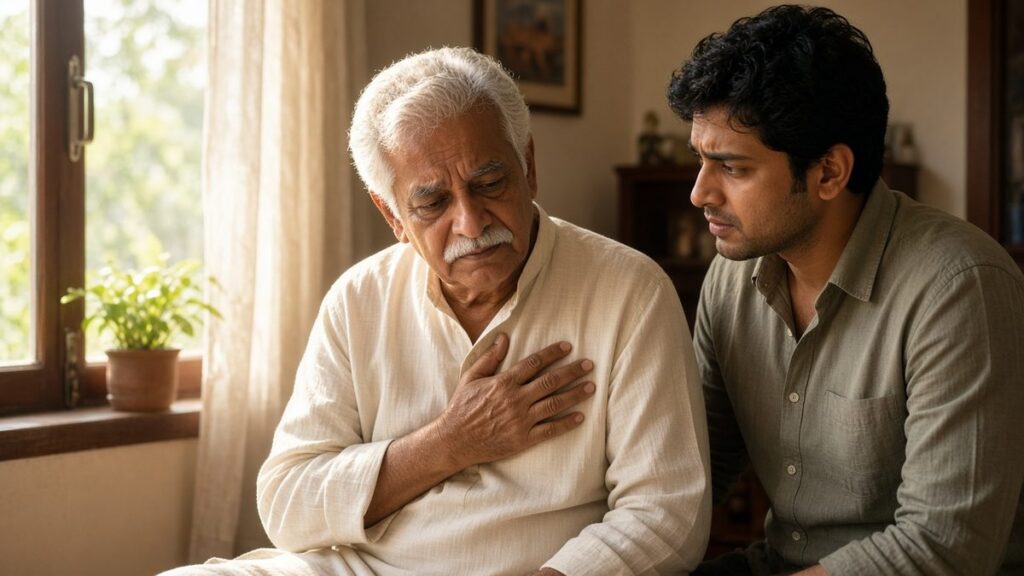
World COPD Day falls on 18 November 2026. It is a good moment to clear up a confusion that comes up again and again in Indian families: is it asthma or COPD? Both cause cough, breathlessness and wheeze. Both may be treated with inhalers. Older relatives often use the words interchangeably, and some people are told they have “a bit of both”.
This guide explains asthma vs COPD in plain language: what each condition is, how they usually differ, where they overlap, the Indian risk factors that matter, and the questions worth asking your doctor about lung function testing. It is not a way to diagnose yourself. Only a doctor can do that, usually with tests.
This article is general education, not medical advice. Please do not use it to diagnose yourself or anyone else, and never start, stop or change any medicine based on a blog post. If someone is struggling to breathe, call 112 immediately.
1. What is asthma?
Asthma is a long-term condition in which the airways are inflamed and sensitive. When something triggers them, such as allergens, smoke, cold air, infections or exercise, the airways can tighten, swell and make extra mucus. That leads to symptoms like wheeze, cough, chest tightness and breathlessness.
A key feature of asthma is that the narrowing of the airways is usually variable and reversible. Symptoms often come and go, and lung function can improve a lot with treatment or on its own. Asthma often starts in childhood, but it can begin at any age. Our guide to adult-onset asthma covers asthma that starts later in life, and our overview of types of asthma explains the different patterns.
2. What is COPD?
COPD stands for chronic obstructive pulmonary disease. It is a long-term lung condition in which airflow is persistently limited, usually because of long exposure to harmful particles or gases. It includes changes such as chronic bronchitis, where the airways are inflamed and produce mucus, and emphysema, where the air sacs are damaged.
In COPD, the airflow limitation is usually persistent and only partly reversible. Symptoms such as breathlessness on exertion, daily cough and phlegm often build slowly over years and may gradually get worse.
3. Asthma vs COPD: the usual differences
These are typical patterns, not rules. Many people do not fit neatly into one box.
- Age of onset: asthma often starts in childhood or young adulthood, though it can begin later. COPD usually shows up in people over 40.
- Main causes: asthma is linked with allergies, family history and airway sensitivity. COPD is mostly linked with long-term exposure to tobacco smoke, biomass smoke, dust and fumes.
- Pattern of symptoms: asthma symptoms often vary from day to day and may be worse at night or early morning, or with triggers. COPD symptoms tend to be more constant and slowly progressive.
- Reversibility: in asthma, airway narrowing often improves well with treatment. In COPD, some limitation remains.
- Allergy history: allergies, eczema or hay fever are more common alongside asthma.
- Phlegm: a daily productive cough, especially in the mornings, is more typical of COPD.
4. Where they overlap
Some people have features of both conditions. Doctors sometimes describe this as asthma COPD overlap. It may happen, for example, in a person who has had asthma for many years and also smoked, or in someone with long exposure to smoke who also has allergic features.
This matters because treatment approaches can differ. Your doctor will look at your history, symptoms and test results to decide what fits. This is one reason it is important not to self-label or borrow a relative’s inhaler.
5. Indian risk factors to know about
COPD is a significant health issue in India, and some risk factors are especially common here.
5.1 Tobacco smoke
Smoking cigarettes and bidis is a major cause of COPD. Second-hand smoke matters too. Our guide on passive smoking and asthma explains how it affects people around a smoker.
5.2 Biomass and chulha smoke
Cooking or heating with wood, cow dung cakes, crop residue or coal in a chulha, especially in a poorly ventilated kitchen, exposes people to heavy smoke for hours every day. This is an important risk factor for COPD in India, particularly for women in rural homes, even if they have never smoked.
5.3 Outdoor air pollution
Long-term exposure to polluted air can harm the lungs and worsen both asthma and COPD symptoms.
5.4 Work exposures
Dust, fumes and chemicals at work, for example in construction, mining, textile mills, brick kilns and some factories, can contribute to lung disease over time.
5.5 Past lung problems
Childhood chest infections, past tuberculosis and long-standing poorly controlled asthma may all affect lung health later in life. Discuss your full history with your doctor.
6. Signs that should prompt a check-up
See a doctor if you or a family member has:
- breathlessness that is slowly getting worse, especially on stairs or walking
- a cough with phlegm most days for months
- frequent chest infections or wheeze every winter
- a long history of smoking or exposure to chulha smoke, even if symptoms seem mild
- asthma that no longer seems to settle between flare-ups
Older adults often put breathlessness down to age. Our guide on managing asthma in the elderly covers some of the special issues for seniors.
7. How doctors tell them apart
Doctors use a combination of history, examination and tests. The most important test is usually spirometry, a breathing test in which you blow hard into a machine. It measures how much air you can breathe out and how fast. Often it is repeated after a reliever medicine to see how much the airways open up.
Your doctor may also suggest other tests, such as a chest X-ray, blood tests or further lung function tests, depending on your situation.
7.1 Questions to ask about lung function testing
- Do I need spirometry, and where can I get it done?
- Will you test before and after a reliever medicine?
- Should I stop or continue any of my current medicines before the test? (Always follow your doctor’s advice on this.)
- What do my results mean, and do they point more to asthma, COPD or both?
- How often should the test be repeated?
- Should I see a chest specialist?
If you are unsure which specialist to see, our guide on ENT vs pulmonologist vs allergist can help.
8. Living well with either condition
While treatment differs, some steps help lung health in both:
- Avoid tobacco smoke, including second-hand smoke. If you smoke, ask your doctor for help to quit.
- Reduce indoor smoke: use cleaner fuels where possible and ventilate the kitchen well.
- Learn your inhaler technique and follow the plan your doctor gives you.
- Stay as active as your doctor advises.
- Ask your doctor about vaccinations that may be recommended for you.
- Have a written action plan for flare-ups.
9. When it is an emergency
Call 112 or go to the nearest emergency department if someone:
- is severely breathless or cannot speak in full sentences
- has blue or grey lips or fingertips
- is confused, very drowsy or exhausted from breathing
- is not improving with their reliever
Siddhant’s POV: Why the right label matters
I have lived with asthma for more than 30 years. My breathing improved after I moved from Delhi NCR to Dehradun.
My view is that a persistent cough or breathlessness deserves assessment, not a label chosen by relatives or an internet checklist. I would encourage families to ask a clinician about the difference between asthma and COPD and whether testing is appropriate. I believe World COPD Day is an opportunity for a respectful conversation, without assuming someone’s diagnosis from their age or smoking history.
Siddhant Jain, founder of Asthma Friend, has lived with asthma for more than 30 years.
Conclusion
Asthma and COPD share symptoms, but they are different conditions. Asthma usually involves variable, reversible airway narrowing often linked with triggers and allergies, while COPD usually involves persistent airflow limitation linked with long exposure to smoke, biomass fuel, pollution or dust. Some people have features of both. Only a doctor can tell which applies, usually with spirometry. On this World COPD Day, if you or someone in your family has long-standing breathlessness or cough, book a check-up, and call 112 in any breathing emergency.
Take the next step with Asthma Friend
- Join our community: Connect with people who understand life with asthma at Asthma Friend.
- Learn through play: Explore free educational games at Asthma Friend Games.
- Create your free asthma action plan: Use the Asthma Friend Action Plan Generator and keep a copy where you and your family can find it.
Frequently asked questions
Asthma usually involves airway narrowing that varies and often reverses with treatment, while COPD involves persistent airflow limitation that does not fully reverse. Only a doctor can confirm which one you have.
Yes. Some people have features of both, sometimes described as asthma COPD overlap. A doctor will assess this using history and tests.
Yes. Long exposure to biomass or chulha smoke, outdoor pollution, workplace dust and fumes, and some past lung illnesses can contribute to COPD in people who have never smoked.
Spirometry is the key breathing test. It is often done before and after a reliever medicine to see how much the airways open up.
World COPD Day 2026 falls on Wednesday, 18 November.
No. Asthma and COPD may need different treatment, and only your doctor can decide what is right for you.
Free: Smog Season Survival Guide
A practical 27-page guide to breathing easier with asthma through India's pollution months: AQI explained, clean air at home, masks, kids and school, plus printable checklists. Join the free Asthma Friend newsletter and we'll email it to you.


Last reviewed: 8 November 2026
Information on this page was written against widely published guidance from national and international respiratory health bodies. It is educational only and is not a substitute for personal medical advice from a doctor.

About the author
Siddhant Jain
Siddhant Jain is the founder of Asthma Friend. He has lived with asthma for more than 30 years. After moving from Delhi NCR to Dehradun, his breathing improved, and he built Asthma Friend to give Indian patients and caregivers practical, empathetic education. The content is educational and is not a substitute for advice from a doctor.